When we imagine a gentlewoman in Regency England, we often picture elegant drawing rooms, afternoon calls, dances, music, embroidery, and leisurely walks through the countryside. What we sometimes forget is how precarious that comfortable existence could be.
For a woman of the gentry, financial security depended largely upon the men in her life. Her father might provide for her while she was unmarried, and a husband was expected to support her after marriage. But what happened when there was no father, no husband, no substantial inheritance, and no wealthy relative willing to provide a home?
For many women, the answer was simple and frightening: she had to work.
The difficulty was that, in Regency society, earning one's own living could change how a woman was perceived. A gentlewoman who entered paid employment did not necessarily cease to be a lady by birth or education, but she could lose social standing. The very necessity of working announced that she lacked the independent income considered appropriate to her class.
This uncomfortable reality is one of the reasons marriage and financial security loom so large in Jane Austen's novels.
The Ideal of the Gentlewoman
Among the gentry and upper classes, a woman's accomplishments were highly valued, but those accomplishments were generally intended for the private sphere.
A lady might play the pianoforte, sing, paint, draw, embroider, speak French or Italian, and possess an extensive knowledge of literature. These abilities could make her admired and accomplished.
But there was a peculiar contradiction at the heart of Regency society.
A woman might be praised for playing the pianoforte beautifully in her own drawing room, but if she needed to earn money by teaching another woman's daughters to play, her social position changed.
She might be admired for her exquisite needlework, but sewing garments for wages placed her much lower on the social scale.
The dividing line was not always the work itself.
It was whether she needed to be paid for doing it.
What Work Could a Gentlewoman Do?
For a well-educated woman who had fallen upon difficult circumstances, the respectable choices were limited.
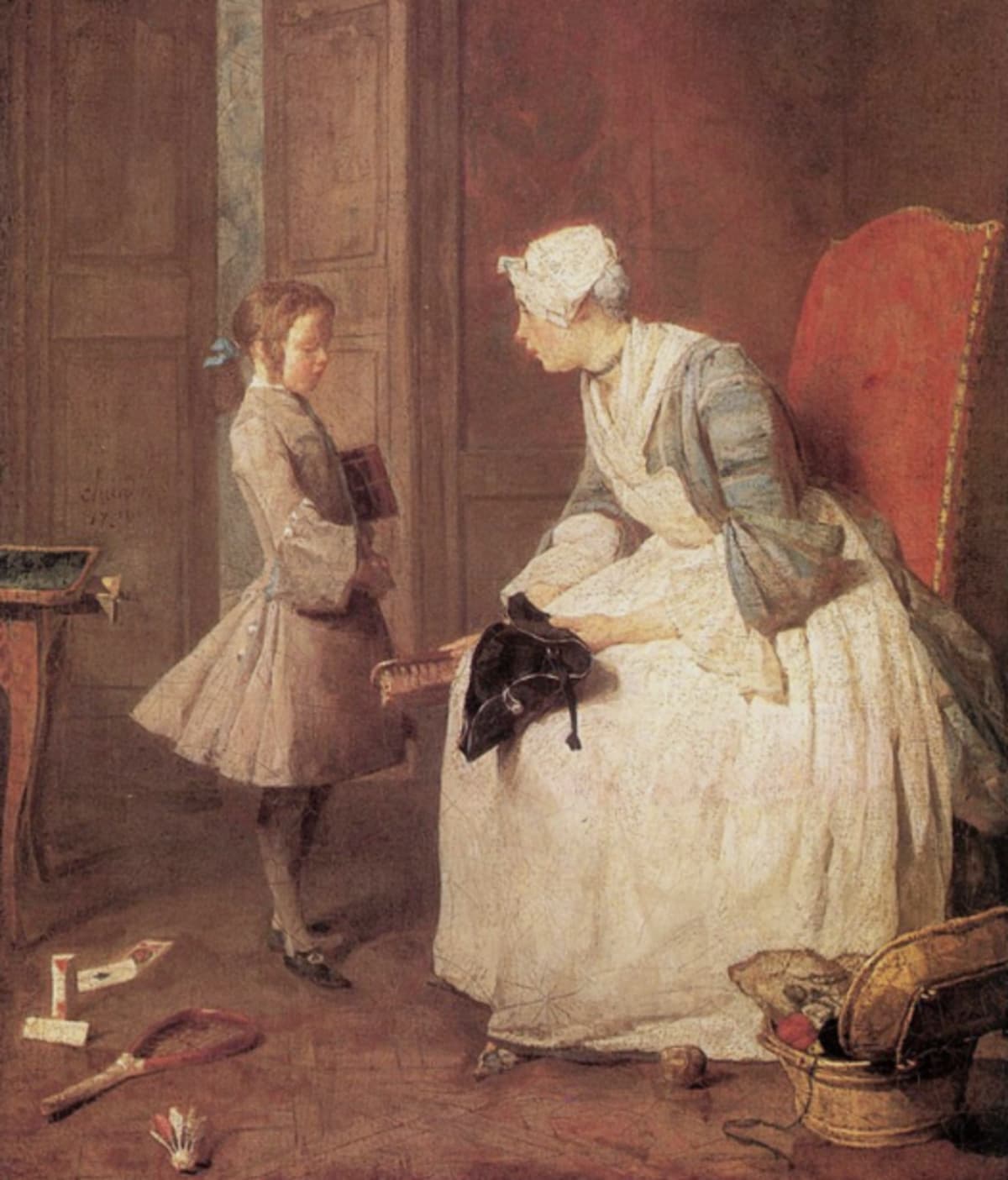
The most obvious was becoming a governess. A governess taught the daughters of wealthy families subjects such as reading, writing, arithmetic, geography, history, French, music, drawing, and proper manners. The position was considered suitable for an educated gentlewoman because she was using the same accomplishments she had been taught as a lady. Education and childcare were among the few respectable avenues by which a woman of a genteel background could support herself.
But the governess occupied an uncomfortable position within the household. She was not quite a servant, but neither was she a member of the family. She might dine separately from the servants because she was socially above them, while simultaneously being excluded from the family's social circle because she was an employee.
A gentlewoman might also become a schoolmistress or establish a small school for girls. This could offer greater independence than being a governess, although starting such a school required money, suitable premises, and pupils willing to pay. Jane Austen gives us an example in Emma through Mrs. Goddard, who runs a respectable school.
A woman with exceptional musical ability might give music or singing lessons, while one skilled in drawing or painting might teach those accomplishments. Teaching French or Italian could also provide income.
A woman might serve as a paid companion to an elderly or wealthy lady. Like the governess, the companion occupied an ambiguous social position. She might be treated almost as a friend in one household and little better than a servant in another.
A widow or unmarried woman with sufficient capital might take in boarders or lodgers. A woman might also earn money through writing, translation, or publishing, although very few could depend upon authorship alone for financial security. Jane Austen herself earned money from her novels, but she spent much of her adult life financially dependent upon members of her family.
These occupations allowed a woman to preserve at least some claim to gentility because they depended upon education and accomplishments rather than physical labor.
When Respectable Work Became "Demeaning"
The farther a gentlewoman descended into domestic service or manual labor, the greater the perceived loss of status.
Becoming a lady's maid, housemaid, nursery maid, cook, laundress, or scullery maid would have represented a dramatic social descent for a woman born into the gentry.
A lady's maid might possess considerable skill and occupy an important position within a wealthy household, but she was nevertheless a servant.
The same was true of sewing.
Fine embroidery performed for pleasure was an accomplishment. Working as a seamstress or dressmaker because one needed wages belonged to a different social world. Such work could involve long hours and uncertain pay.
Women also worked as shopkeepers, innkeepers, agricultural laborers, factory workers, domestic servants, washerwomen, market sellers, dairy workers, and in numerous family businesses. Such occupations were perfectly ordinary among working women. What made them "demeaning" in the eyes of Regency society was not that the work lacked value, but that the rigid class system regarded manual and commercial labor as inappropriate for a woman who claimed the status of a gentlewoman.
That distinction is important. The work itself was necessary and often highly skilled. The stigma came from the society surrounding it.
Jane Fairfax and the Dreaded Governess Trade
Perhaps Jane Austen's clearest exploration of this problem appears in Emma.
Jane Fairfax is beautiful, intelligent, accomplished, and well educated, but she has almost no fortune. Without marriage or financial assistance, she expects that she will eventually have to become a governess.
For Jane, this is not merely a career decision. It represents the loss of the life she has known.
Her situation reveals one of the cruel contradictions faced by genteel women. Jane possesses exactly the education and accomplishments society admires in a lady. Those same accomplishments qualify her for employment. Yet the moment she must sell those accomplishments for wages, society places her in a lower and more vulnerable position.
Miss Taylor, Emma Woodhouse's former governess, provides an interesting contrast. She is loved and respected within the Woodhouse household and eventually becomes Mrs. Weston. Her story demonstrates that a governess could be treated with affection and dignity, but her fortunate circumstances were by no means guaranteed.
The Bennet Sisters and the Shadow of Financial Insecurity
The issue also hovers in the background of Pride and Prejudice.
Mr. Bennet's estate is entailed away from his daughters. Mrs. Bennet may be foolish in many respects, but her fear for her daughters' futures has a very real foundation.
If Mr. Bennet were to die, Longbourn would pass to Mr. Collins. Mrs. Bennet and her five daughters would have to leave their home and depend upon Mrs. Bennet's relatively modest fortune and whatever assistance their relatives might provide.
For Elizabeth and Jane, marriage is not merely romantic. Their financial futures are intimately connected with it.
This is one reason Elizabeth's rejection of Mr. Collins is so significant. She refuses financial security when accepting it would mean marrying a man she cannot respect. Later, she rejects Darcy's first proposal despite his enormous fortune. Elizabeth insists upon something Regency society did not always allow women the luxury of demanding: a marriage she could enter with respect and affection.
A Woman's Status Could Change Overnight
A gentlewoman's place in society could be surprisingly fragile.
The death of a father might reveal that the family fortune was smaller than everyone believed. An entail might send the family estate to a distant male relation. A husband's death could leave a widow poorly provided for. A failed investment might destroy an inheritance.
A woman who had spent her entire life as a gentleman's daughter might suddenly find herself faced with a terrible question:
How shall I live?
Her education might save her from starvation, but it could not necessarily preserve her social position.
A governess could support herself.
A companion could provide herself with a home.
A schoolmistress could earn an income.
But each choice reminded society that she was no longer a woman of independent means.
Elizabeth Bennet and the Possibility of Work in My Variations
This question of women's financial vulnerability is something I touch upon in my Pride and Prejudice variations Forsaking All Others and Dearly Beloved.
Elizabeth Bennet fleetingly considers what she might do if circumstances forced her to earn her own living. For a woman of Elizabeth's intelligence and education, the possibilities would exist, but they would be painfully limited.
Could she become a governess?
Could she teach?
Could she serve as a companion?
The Elizabeth we know is intelligent, capable, and independent in spirit. But Regency society did not necessarily reward those qualities in a woman who lacked money.
That tension fascinates me as a writer.
Elizabeth might possess all the intelligence required to manage an estate, yet the estate would belong to a man. She might understand accounts and household management, but she could not expect to enter the professions open to her male contemporaries. She might be better read than many gentlemen, but education alone did not guarantee her financial independence.
For women like Elizabeth Bennet, Jane Bennet, and Jane Fairfax, the distance between comfortable gentility and financial dependence could be alarmingly small.
It is one of the reasons I find the women of Jane Austen's world so compelling. Their choices were constrained in ways that are sometimes difficult for modern readers to imagine. Yet within those constraints, Austen's heroines seek dignity, affection, security, and the right to make choices about their own futures.
Behind every beautiful Regency drawing room was an economic reality.
For a gentlewoman without money, the question was not simply whether she was willing to work.
It was whether society would still consider her a lady once she did.
How To Connect With Me
Thank you for taking the time to read my blog.
If you enjoy exploring the history behind Jane Austen's world as much as I do, I hope you'll follow me here on Goodreads for future blog posts and updates on my latest book releases. You can also follow me on Amazon to be notified whenever I publish a new novel.
I'd love to connect with you on social media as well! You can find me on Instagram, Facebook, and TikTok, where I share updates on my writing, historical research, and all things Pride and Prejudice.
Book Reviews and Recommendations
If you've read one of my books, I would be truly grateful if you would consider leaving an honest review on Amazon. Star Ratings and Reviews are incredibly important to independent authors. They help other readers discover our books and make a tremendous difference in helping our stories reach new audiences.
Thank you so much for your support, and happy reading!
— Lily Michaels
Goodreads Giveaway
Forsaking All Others, A Pride and Prejudice Variation
https://www.goodreads.com/giveaway/show/444599-forsaking-all-others-a-pride-and-prejudice-variation
Follow on Amazon
https://www.amazon.com/author/lilymichaels-prideandprejudice
Follow on Facebook
https://www.facebook.com/profile.php?id=61585528987332
Subscribe to my email for updates on new releases