When a Letter Could Not Wait: The Express in Regency England
Today, when we have urgent news to share, we can make a telephone call, send a text, or write an email and expect it to arrive almost immediately. In Regency England, communication over any distance was much more complicated. For most people, the letter was the principal means of communicating with family, friends, and business associates who lived elsewhere. Letters traveled surprisingly efficiently through the British postal system, but even the regular post was not always fast enough.
When the news was truly urgent, there was another option: the express.
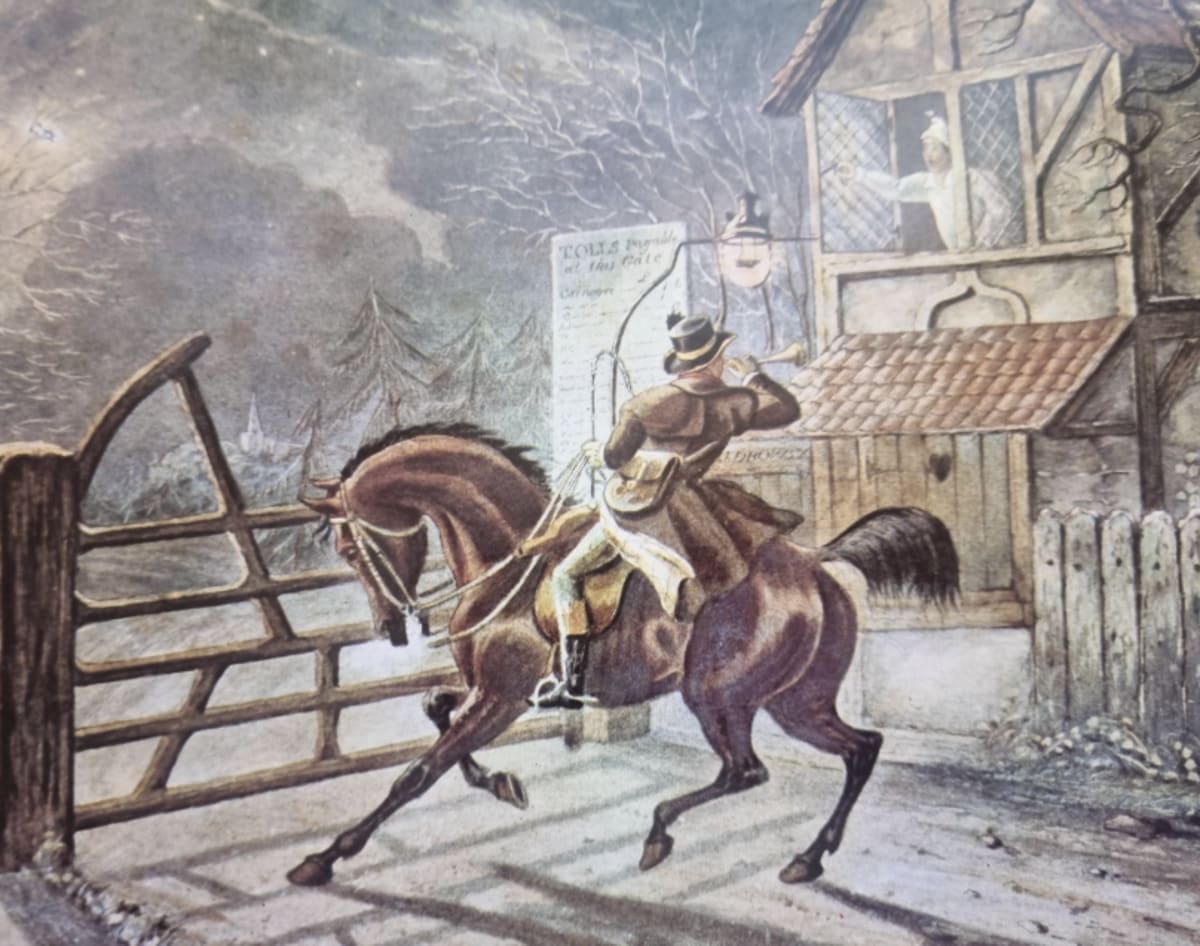
An express was a message sent with the intention of reaching its recipient as quickly as possible rather than waiting upon the ordinary course of the post. A special messenger could be dispatched with the letter and travel directly toward its destination, using horses and the posting system along the route as necessary.
The important difference between an ordinary letter and an express was urgency. An ordinary letter joined the established postal system and traveled according to its schedules. An express was sent because the sender believed the matter could not wait.
That distinction would have been immediately understood in a Regency household. The arrival of an ordinary letter might cause curiosity or pleasure. The unexpected arrival of an express could cause alarm before anyone had even broken the seal.
Why Send an Express?
An express was not something one ordinarily used to send an invitation, exchange family news, or inquire after a friend. It was more expensive than ordinary correspondence because speed required special arrangements, horses, riders, and sometimes changes along the route.
For that reason, an express was generally reserved for important business or circumstances in which even a few hours might matter. Serious illness, death, an accident, a family crisis, an unexpected disappearance, urgent financial or legal business, or some other matter requiring immediate action could justify the expense.
The recipient might need to leave for another part of the country as soon as the message arrived. In such circumstances, the purpose of the express was not merely to convey information. It was to gain time.
For wealthy families, that expense was more easily managed. A gentleman such as Mr. Darcy could send an express when circumstances required one without worrying greatly about the cost. For a family of more modest means, the decision would carry considerably more weight. The situation had to be important enough to warrant paying for extraordinary speed.
How Was This Different From the Regular Post?
Britain had an extensive postal network during the Regency period. Mail coaches had transformed the movement of letters beginning in the late eighteenth century. They traveled established routes and carried mail between towns with considerably greater regularity and speed than had been possible in earlier generations.
But the ordinary post still operated according to a system. A letter had to enter that system, travel along the appropriate postal routes, and be sorted and transferred as necessary before reaching its destination.
An express was different because the message itself was given priority. Instead of simply joining the ordinary flow of correspondence, arrangements were made to carry it onward without the usual delays.
This did not mean that an express traveled at a gallop from London to Derbyshire on a single horse. Horses had limits. For a long journey, fresh horses and sometimes fresh riders would be required. Roads, weather, darkness, and the availability of horses could all affect the journey.
Even so, when someone received an express, he knew that another person had deliberately gone to the trouble and expense of getting that message to him as quickly as circumstances permitted.
Jane Austen and the Express
Jane Austen gives us an excellent example in Pride and Prejudice.
When Lydia Bennet disappears from Brighton with George Wickham, Colonel Forster does not simply wait to send the Bennets the news in an ordinary letter. Jane tells Elizabeth that an express arrived at Longbourn at midnight informing the family of Lydia's disappearance.
Later, when Mr. Gardiner finally discovers Lydia and Wickham in London, another express arrives at Longbourn. Mrs. Hill is so interested in its arrival that she seeks out Jane and Elizabeth to ask whether they have received good news. Mr. Bennet confirms that he has received a letter from Mr. Gardiner “by express.”
Austen did not need to explain to her contemporary readers why this mattered. They understood immediately. An express meant important news.
There is another interesting example in Sense and Sensibility, although Austen does not specifically identify the communication as an express.
While everyone is gathered for breakfast before an intended excursion, the letters arrive. Colonel Brandon receives one, looks at the direction, changes color, and immediately leaves the room. He soon announces that he must go to London. We later learn that the matter concerned his ward, Eliza Williams, who had disappeared and had finally been found in desperate circumstances.
Austen calls this communication a letter, not an express, so we cannot say that Colonel Brandon actually received one. However, the circumstances are certainly the sort that could have justified an express. His response also demonstrates something important about Regency communication: sometimes a letter did not merely bring news. It required the recipient to act immediately.
The Express in Regency Fiction
I have used expresses in several of my own Pride and Prejudice variations, most recently in Forsaking All Others, A Pride and Prejudice Variation.
I will not tell you what emergency prompts the express because I do not want to spoil the story. But it is one of those historical details I enjoy incorporating into my books because it allows the characters to respond to a crisis in a manner appropriate to their time.
When writing Regency fiction, it is tempting to forget just how dependent people were upon written communication. A character could not simply telephone Pemberley from London or send a quick message to Longbourn. Someone had to put pen to paper. The letter then had to physically travel every mile separating the writer from the recipient.
If the matter was sufficiently serious, however, there was another choice. Send an express.
For the recipient, the sight of that unexpected messenger arriving at the door could say something before the letter was ever opened.
Something had happened. And someone believed it could not wait.
How To Connect With Me
Thank you for taking the time to read my blog.
If you enjoy exploring the history behind Jane Austen's world as much as I do, I hope you'll follow me here on Goodreads for future blog posts and updates on my latest book releases. You can also follow me on Amazon to be notified whenever I publish a new novel.
I'd love to connect with you on social media as well! You can find me on Instagram, Facebook, and TikTok, where I share updates on my writing, historical research, and all things Pride and Prejudice.
Book Reviews and Recommendations
If you've read one of my books, I would be truly grateful if you would consider leaving an honest review on Amazon. Star Ratings and Reviews are incredibly important to independent authors. They help other readers discover our books and make a tremendous difference in helping our stories reach new audiences.
Thank you so much for your support, and happy reading!
— Lily Michaels
Goodreads Giveaway
Forsaking All Others, A Pride and Prejudice Variation
https://www.goodreads.com/giveaway/show/444599-forsaking-all-others-a-pride-and-prejudice-variation
Follow on Amazon
https://www.amazon.com/author/lilymichaels-prideandprejudice
Follow on Facebook
https://www.facebook.com/profile.php?id=61585528987332
Subscribe to my email for updates on new releases
https://lilymichaels.com/
July 28, 2026
When a Letter Could Not Wait: The Express in Regency England