The Smoke Over Regency London
When we picture Regency London, it is easy to think first of elegant townhouses, fashionable shops, theaters, assembly rooms, and carriages filling the streets. What is less appealing to imagine is the air.
London was already a smoky and dirty city during Jane Austen's lifetime. The severe industrial pollution associated with later Victorian London had not yet reached its height, but smoke had troubled the capital for centuries. By the Regency period, a large and growing population depended heavily upon coal for heat, cooking, and industry. Thousands upon thousands of fires sent their smoke through chimneys and into the air above the city.
For anyone accustomed to the countryside, the difference must have been noticeable.
A City Heated by Coal
Coal was one of the principal sources of London's air pollution. It was brought into the city in enormous quantities and burned in household fireplaces as well as by businesses and industries.
A prosperous London house might contain fireplaces in the drawing room, dining room, library, bedrooms, and other important rooms. During cold weather, several could be burning at the same time. Multiply those fires by the thousands of houses crowded together across London, then add workshops and other commercial fires, and the source of much of the city's smoke becomes apparent.
Chimneys carried smoke away from individual rooms, but they did not make it disappear. They simply released it above the streets.
Coal smoke contained soot and other pollutants. It could settle upon buildings, clothing, windows, and household furnishings. Servants faced the continual work of dealing with ashes, coal dust, and soot inside the house as well.
London had struggled with coal smoke long before the Regency. Complaints about the effects of burning coal went back hundreds of years, and earlier attempts had been made to restrict particularly smoky activities. The problem persisted because coal had become too useful and too important to the city to abandon.
When Smoke Met Fog
London's natural geography contributed to another familiar problem: fog.
The city lies in the Thames Valley, where damp conditions could produce natural fog. When that moisture combined with smoke from coal fires, the result could be a much dirtier and more unpleasant atmosphere.
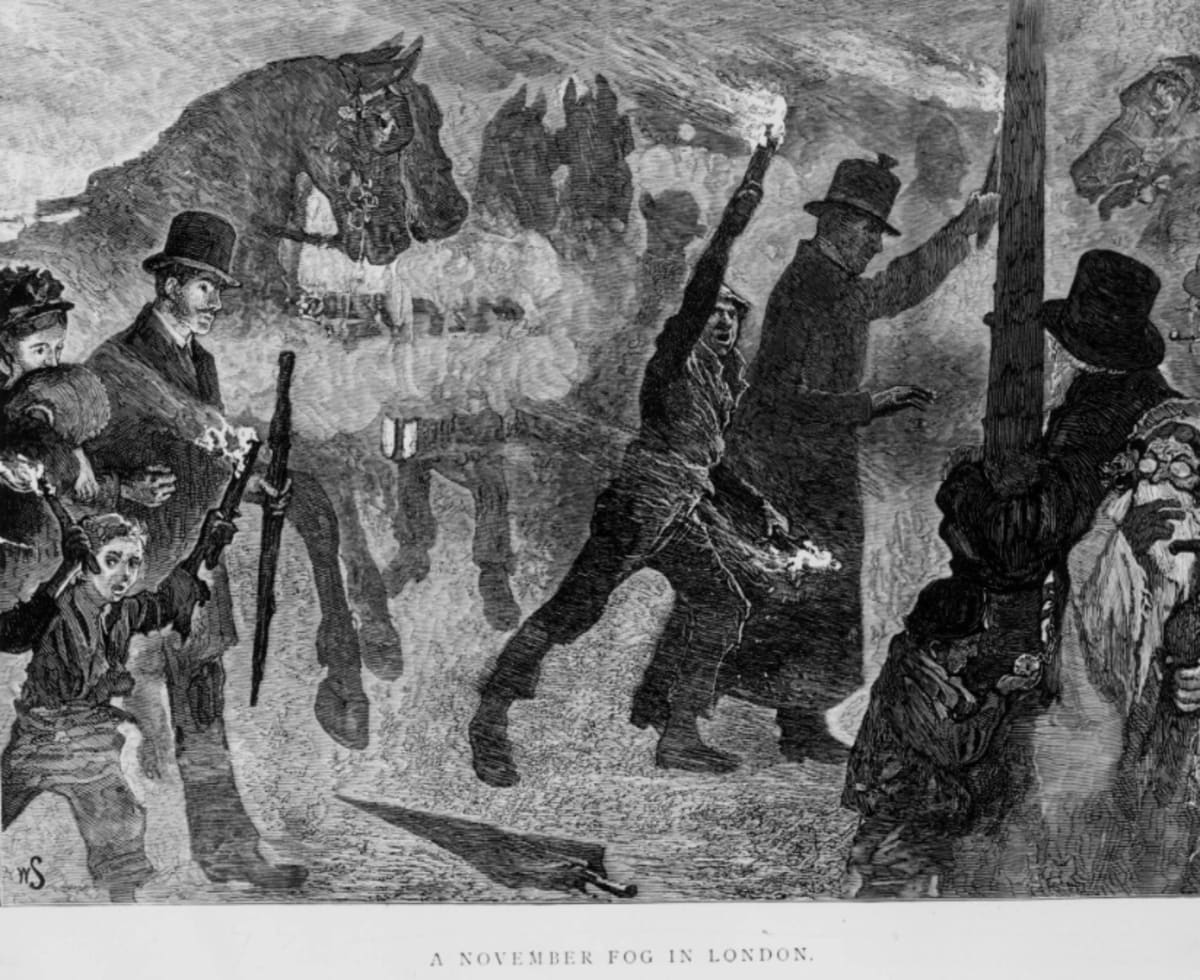
Visitors described London as being enveloped in a mixture of fog and smoke. On particularly bad days, visibility could become poor and the air heavy.
We should be careful, however, not to impose the London of the late nineteenth century upon the Regency. The famous dense "pea-soup" fogs associated with Victorian London became increasingly severe as London's population and industry expanded during the nineteenth century. The Great Smog of 1952 belonged to an entirely different period.
But the basic problem was already there during Jane Austen's lifetime. Regency London could be smoky, hazy, and dirty, particularly when weather conditions prevented smoke from dispersing.
Pollution Was Not Only in the Air
Smoke was only one of the unpleasant realities of Regency London.
The streets themselves could be filthy. Horses provided much of the city's transportation, pulling private carriages, hackney coaches, carts, wagons, and other vehicles. With so many horses came manure and urine.
Mud presented another problem. Rain mixed with dirt and refuse in the streets, while gutters and drains carried waste. Passing carriages could splash pedestrians and the fronts of buildings.
Household and commercial refuse also had to be removed in a city without modern sanitation services. London was crowded, noisy, smoky, and often foul-smelling in ways that would be startling to a modern visitor.
The Thames itself received waste from the growing city. The notorious pollution of the river became much worse as London's population increased later in the nineteenth century, but sewage and other refuse were already part of the problem during the Regency.
For wealthy people, money provided some protection from these conditions. They could travel in private carriages rather than walking through dirty streets, live in fashionable neighborhoods, employ servants to keep their houses clean, and leave London for country estates.
They could not, however, entirely escape the city's air.
Elizabeth Bennet and the Outdoors
I mention London's atmosphere only briefly in some of my Pride and Prejudice variations, usually in connection with Elizabeth Bennet and her love of being outdoors.
Elizabeth is a wonderful character for illustrating the contrast between town and country because Jane Austen establishes her as a great walker. She walks through fields, crosses stiles, enjoys the countryside, and is not particularly troubled if a little mud finds its way onto her petticoat.
But country mud and London dirt were two very different things.
I can easily imagine Elizabeth enjoying London's theaters, bookshops, museums, and society while still longing for Hertfordshire or Derbyshire, where she could walk beneath an open sky and breathe country air.
When I send Elizabeth outside in one of my books, I sometimes give a brief thought to what she would actually encounter. In London that might mean smoke from countless chimneys, crowded streets, horses, carriages, mud, and the smells of a large city. At Longbourn or Pemberley, her surroundings would be very different.
It is one of the reasons I particularly enjoy writing Elizabeth at Pemberley. There she can do something that suits her nature perfectly: walk.
Jane Austen's London
Jane Austen knew London herself and visited it numerous times. Her brother Henry lived there, and she stayed with him while conducting some of the business associated with publishing her novels.
London also appears in her fiction.
In Sense and Sensibility, Elinor and Marianne Dashwood travel to London with Mrs. Jennings and stay near Portman Square. Their time there includes calls, parties, shopping, letters, gossip, and, for Marianne, considerable heartbreak.
Austen does not use their visit to give us a detailed account of London's pollution. Her attention remains where it usually does: upon people and their relationships. Her contemporary readers did not need an explanation of what London streets smelled like or what came from a coal-burning chimney. Those things were part of ordinary life.
That is one of the challenges I enjoy when writing Regency fiction. Some historical details should be explained because they are unfamiliar to modern readers. Others need only a sentence or two to remind us that Elizabeth Bennet's world was not ours.
The London she knew could be exciting, fashionable, and filled with opportunity. It could also be crowded, dirty, and smoky.
For a woman who delighted in a long country walk, I think the green fields beyond the city would sometimes have been very welcome indeed.
How To Connect With Me
Thank you for taking the time to read my blog.
If you enjoy exploring the history behind Jane Austen's world as much as I do, I hope you'll follow me here on Goodreads for future blog posts and updates on my latest book releases. You can also follow me on Amazon to be notified whenever I publish a new novel.
I'd love to connect with you on social media as well! You can find me on Instagram, Facebook, and TikTok, where I share updates on my writing, historical research, and all things Pride and Prejudice.
Book Reviews and Recommendations
If you've read one of my books, I would be truly grateful if you would consider leaving an honest review on Amazon. Star Ratings and Reviews are incredibly important to independent authors. They help other readers discover our books and make a tremendous difference in helping our stories reach new audiences.
Thank you so much for your support, and happy reading!
— Lily Michaels
Goodreads Giveaway
Forsaking All Others, A Pride and Prejudice Variation
https://www.goodreads.com/giveaway/show/444599-forsaking-all-others-a-pride-and-prejudice-variation
Follow on Amazon
https://www.amazon.com/author/lilymichaels-prideandprejudice
Follow on Facebook
https://www.facebook.com/profile.php?id=61585528987332
Subscribe to my email for updates on new releases
https://lilymichaels.com/
July 29, 2026