When we think of Regency England, our imaginations often turn to country estates, assembly rooms, elegant gowns, afternoon calls, and young ladies hoping to catch the eye of an eligible gentleman. Yet beyond those drawing rooms, Britain was engaged in a long and brutal struggle against Napoleon Bonaparte.
One of the most important chapters of that struggle was the Peninsular War, fought primarily in Portugal and Spain from 1808 until 1814.
For Britain, the Peninsular War became one of the defining military campaigns of the age. Thousands of British soldiers crossed the sea to fight alongside Portuguese and Spanish forces against Napoleon's armies. The campaign helped make Arthur Wellesley, the future Duke of Wellington, a national hero and eventually carried British troops across the Pyrenees and into France itself.
Although Jane Austen rarely brought the battlefield directly into her novels, she lived and wrote during these years. The officers, militia regiments, naval men, military news, and anxieties of wartime that appear throughout her world belonged to a nation that had been at war for much of her adult life.
As a writer of Pride and Prejudice variations, I find this history fascinating, and I touch upon the Peninsular War and the larger conflict with Napoleon in several of my own books. It provides a powerful historical background for characters whose lives could be dramatically altered by military service, separation, injury, and the uncertainty of whether a loved one would ever return home.
What Was the Peninsular War?
The Peninsular War was fought on the Iberian Peninsula, primarily in Spain and Portugal.
It began in 1808 after Napoleon's forces occupied Portugal and intervened in Spain. Napoleon eventually forced the Spanish king to abdicate and placed his own brother, Joseph Bonaparte, upon the Spanish throne.
The result was fierce resistance.
The Spanish people rebelled against French occupation, while Portugal also resisted Napoleon's forces. Britain saw an opportunity to establish a major land campaign against France and sent troops to Portugal.
In August 1808, a British force under Lieutenant General Arthur Wellesley landed in Portugal.
Wellesley soon defeated French forces at Roliça and Vimeiro. Although political and military complications temporarily removed him from command, he returned to Portugal in 1809.
The man history would remember as the Duke of Wellington had begun the campaign that would make him famous.
Britain, Portugal, and Spain Fight Together
One of the most important aspects of the Peninsular War is sometimes overlooked.
Britain did not defeat the French in Iberia alone.
British soldiers fought alongside Portuguese and Spanish forces, while Spanish guerrillas waged a relentless campaign against French occupation.
The Portuguese Army was reorganized and trained with British assistance and became an increasingly effective fighting force. Spanish armies continued to resist Napoleon's troops despite suffering devastating defeats, while local guerrilla fighters attacked French communications, convoys, and isolated units.
The word "guerrilla," meaning "little war," entered widespread usage because of this conflict.
Napoleon's armies could capture cities and defeat armies in battle, but controlling the countryside was far more difficult.
French troops found themselves fighting not merely an opposing army but populations determined to resist occupation.
Wellington's Strategy
Wellington understood that defeating Napoleon's forces required more than courage upon the battlefield.
It required patience.
He was particularly skilled at choosing defensive positions, maintaining supply lines, and refusing battle when circumstances favored his enemy.
One of his greatest achievements was the construction of the Lines of Torres Vedras in Portugal.
These enormous defensive works consisted of a series of fortified lines protecting Lisbon. They were constructed largely in secrecy beginning in 1809.
When Marshal André Masséna invaded Portugal in 1810 with a powerful French army, Wellington withdrew behind these defenses.
The French encountered something they had not expected.
An immense fortified barrier stood between them and Lisbon.
Wellington had also employed a scorched earth strategy in areas through which the French would advance, removing food and supplies that might sustain the invading army.
Masséna's troops could neither break Wellington's defenses nor adequately feed themselves.
Eventually, the French were forced to retreat.
It was an extraordinary strategic victory.
Life for the Ordinary Soldier
The romantic image of a handsome officer in a scarlet coat tells only a small part of the story.
Life for soldiers in the Peninsular War could be extraordinarily difficult.
They marched tremendous distances, often carrying heavy equipment upon their backs. Roads could be terrible or nonexistent. Summer heat could be oppressive, while winter brought cold rain and snow.
Food was not always plentiful.
Uniforms wore out.
Boots deteriorated.
Disease was an ever-present danger.
For many soldiers of the period, disease was as dangerous as enemy fire.
Dysentery, fever, infection, and other illnesses could sweep through military camps. Medical treatment was primitive by modern standards, and a seemingly minor wound could become fatal if infection developed.
Letters from home might take weeks or months to arrive.
Families in England could sometimes learn of a battle through newspapers long before they knew whether a husband, brother, or son had survived it.
That uncertainty must have been agonizing.
Women Followed the Army Too
The Peninsular War was not an entirely male world.
A limited number of soldiers' wives were officially permitted to accompany regiments overseas, often chosen by lot when more women wished to travel than the army allowed.
These women endured many of the same hardships as the soldiers.
They marched with the army, washed clothing, prepared food, tended the sick and wounded, and cared for children under extraordinarily difficult circumstances.
Officers' wives sometimes accompanied their husbands as well, although their circumstances could be considerably more comfortable when transportation and servants were available.
War was never confined solely to the battlefield. It affected wives, mothers, sisters, children, and entire communities.
The Battle of Salamanca
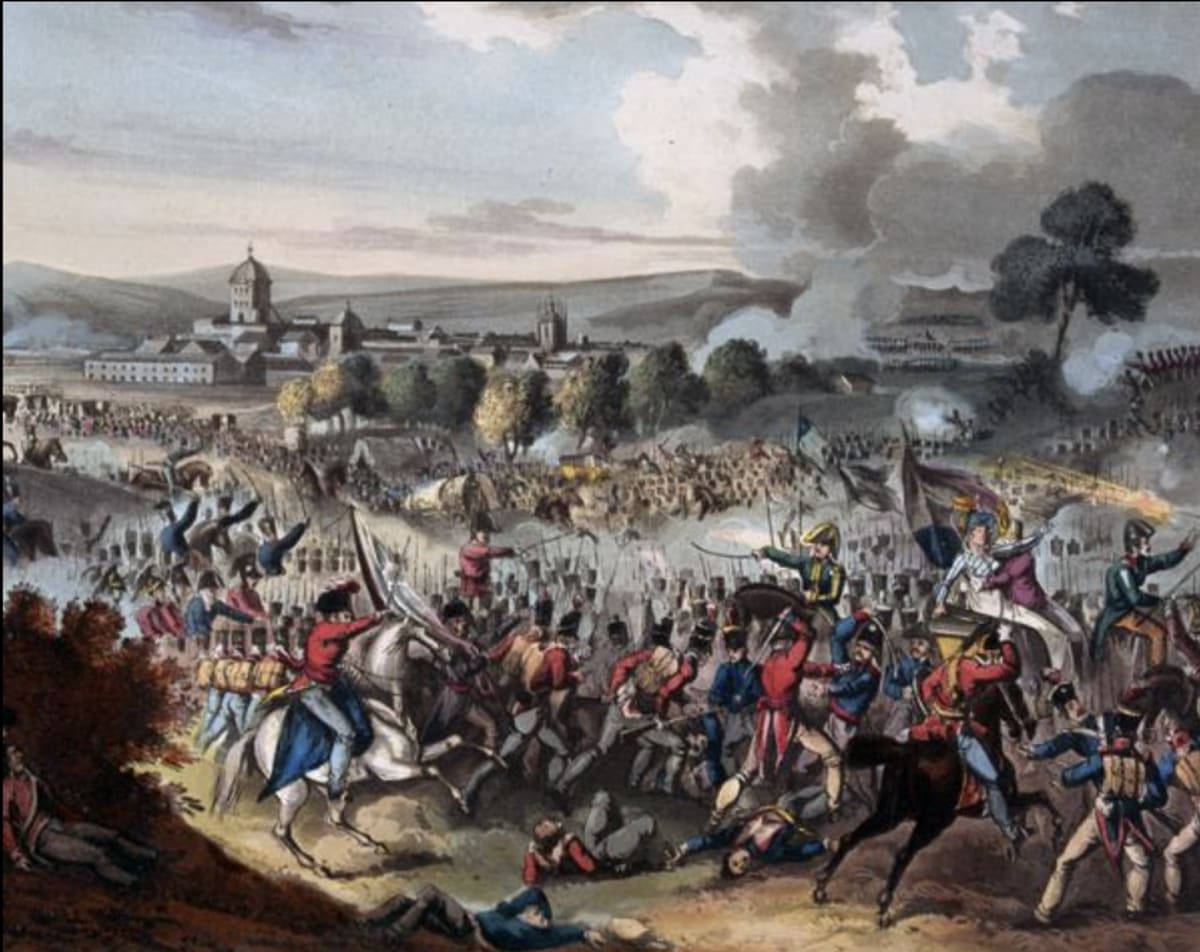
One of Wellington's greatest victories came at Salamanca on July 22, 1812.
The French commander, Marshal Marmont, attempted to maneuver around Wellington's position. In doing so, portions of the French army became dangerously separated.
Wellington recognized the opportunity.
He attacked.
The result was a decisive Allied victory that shattered French dominance in that part of Spain.
The victory at Salamanca demonstrated that Wellington was not merely a cautious defensive commander. When an opportunity presented itself, he could strike with remarkable speed and effectiveness.
British troops subsequently entered Madrid, although the struggle was far from finished.
The Road to Vitoria
By 1813, Napoleon's disastrous invasion of Russia had greatly weakened his empire.
Wellington was ready to advance again.
British, Portuguese, and Spanish forces pushed northward through Spain.
On June 21, 1813, they met the French at the Battle of Vitoria.
The Allied victory was overwhelming.
The French army retreated, abandoning enormous quantities of equipment, supplies, and baggage.
The victory at Vitoria effectively broke French power in Spain and became one of Wellington's greatest triumphs.
The news was celebrated throughout Britain.
Wellington's reputation soared.
But the Peninsular War was still not quite over.
British Soldiers Cross Into France
The Allied armies continued their advance northward.
After years of fighting in Portugal and Spain, Wellington's soldiers crossed the Pyrenees and carried the war onto French soil.
Battles continued into 1814.
By then Napoleon faced enemies on several fronts, and his empire was collapsing.
In April 1814, Napoleon abdicated.
The Peninsular War was over.
For British soldiers who had spent years marching and fighting through Portugal, Spain, and southern France, the long road home could finally begin.
Of course, peace would prove temporary.
Napoleon escaped from exile in 1815 and returned to France, leading to the Hundred Days and the final confrontation at Waterloo.
But that is another story.
What Did People in England Know About the War?
People living in Regency England would have followed the campaign through newspapers, official dispatches, private letters, and conversation.
Major victories became national news.
Wellington became a celebrated figure.
Families with sons or husbands serving overseas followed military reports with particular anxiety.
Imagine reading that your husband's regiment had participated in a terrible battle without knowing whether he had survived.
There were no telephones, photographs sent instantly across oceans, or messages arriving within seconds.
News traveled slowly.
A family might wait weeks for a letter confirming that a loved one was safe.
For a woman whose husband was fighting in Spain or Portugal, every knock at the door carrying correspondence might bring either tremendous relief or devastating news.
Jane Austen's England Was a Nation at War
Jane Austen lived almost her entire adult life against the background of war.
The French Revolutionary Wars began in 1793, when Austen was seventeen, and with only brief interruptions Britain remained at war with France until Napoleon's final defeat in 1815.
Her readers would not have required lengthy explanations about soldiers, militia regiments, naval officers, or military movements.
They lived with these things.
Jane Austen also had personal connections to Britain's military world.
Her brother Henry served as an officer in the militia before becoming a banker and army agent. Her brothers Francis and Charles pursued distinguished careers in the Royal Navy.
War was not some distant historical event to Austen.
It was part of the world in which she lived.
Pride and Prejudice and the Military World
The Peninsular War itself does not become a central subject in Pride and Prejudice, but Britain's wartime society is plainly visible.
The militia stationed near Meryton provides one of the most obvious examples.
Lydia and Kitty Bennet are delighted by the arrival of the officers and their scarlet coats. Their fascination with the militia brings George Wickham directly into the Bennet family's social circle.
The militia, however, should not be confused with Wellington's regular soldiers fighting in Portugal and Spain.
Militia regiments were primarily intended for home defense and generally served within Britain. During a period when invasion by Napoleon remained a genuine fear, such forces formed an important part of Britain's defenses.
The regular army, by contrast, could be sent overseas.
Those were the soldiers who marched with Wellington through Portugal and Spain.
To Jane Austen's original readers, the distinction would have been familiar.
Persuasion and the Men Who Returned From War
The Peninsular War in My Pride and Prejudice Variations
The Peninsular War and the larger conflict against Napoleon have provided a fascinating historical background for several of my Pride and Prejudice variations.
I touch very briefly upon the war in my books because it would have been impossible for the people of Regency England to remain entirely untouched by it.
A gentleman might have a brother serving with Wellington.
A young woman might wait anxiously for letters from a husband overseas.
An officer might return home wounded.
Another might never return at all.
Families might celebrate victories without knowing that those victories had cost another family a beloved son.
For a novelist, the Peninsular War provides far more than battles and military uniforms. It provides separation, uncertainty, courage, sacrifice, grief, and extraordinary opportunities for characters to reveal who they truly are.
Those themes fit naturally into the world of Pride and Prejudice variations.
Darcy and Elizabeth may belong to the world of Pemberley and Longbourn, but beyond their peaceful country estates was another world entirely, one in which British soldiers were marching across Portugal and Spain beneath the blazing Iberian sun.
That contrast is one of the things I find most fascinating about Regency England.
But theirs was also a generation shaped by war.
And while Jane Austen allowed the battles to remain largely beyond the pages of her novels, the men and women who lived through those years would never have forgotten that somewhere beyond England's green fields, their countrymen were fighting their long and bloody road through the Peninsula.
How To Connect With Me
Thank you for taking the time to read my blog.
If you enjoy exploring the history behind Jane Austen's world as much as I do, I hope you'll follow me here on Goodreads for future blog posts and updates on my latest book releases. You can also follow me on Amazon to be notified whenever I publish a new novel.
I'd love to connect with you on social media as well! You can find me on Instagram, Facebook, and TikTok, where I share updates on my writing, historical research, and all things Pride and Prejudice.
Book Reviews and Recommendations
If you've read one of my books, I would be truly grateful if you would consider leaving an honest review on Amazon. Star Ratings and Reviews are incredibly important to independent authors. They help other readers discover our books and make a tremendous difference in helping our stories reach new audiences.
Thank you so much for your support, and happy reading!
— Lily Michaels
Goodreads Giveaway
Forsaking All Others, A Pride and Prejudice Variation
https://www.goodreads.com/giveaway/show/444599-forsaking-all-others-a-pride-and-prejudice-variation
Follow on Amazon
https://www.amazon.com/author/lilymichaels-prideandprejudice
Follow on Facebook
https://www.facebook.com/profile.php?id=61585528987332
Subscribe to my email for updates on new releases
https://lilymichaels.com/
July 21, 2026
The Peninsular War: British Soldiers Fighting Far From Jane Austen's England