Imagine two gentlemen standing opposite one another on a misty field at dawn.
Each holds a pistol.
A few yards away stand their seconds, gentlemen who have arranged the meeting and who still hope, perhaps, that honor can be satisfied without bloodshed.
The quarrel may have begun with an insult, an accusation of dishonesty, an affront to a lady, or an attack upon a gentleman's reputation. Whatever its cause, the dispute has now reached what Regency society called an affair of honor.
The men have come to the field of honor.
It sounds romantic in historical fiction.
In reality, it could end with a man dead and another facing a charge of murder.
I touch upon this dangerous custom in Forsaking All Others, A Pride and Prejudice Variation. Elizabeth fears that Mr. Darcy may feel compelled to defend her honor by meeting the rake Lord Dunwich on the field of honor.
Her fear would have been entirely understandable in 1811.
Were Duels Still Fought in 1811? Absolutely.
Dueling had been practiced among European gentlemen for centuries, and by the eighteenth century it had developed into a highly ritualized means of settling disputes concerning honor.
By Jane Austen's lifetime, pistols had largely replaced swords as the preferred weapons for British duels.
The practice was especially associated with gentlemen, politicians, aristocrats, and military officers. A man's reputation mattered enormously within these circles. To be publicly branded a liar, coward, cheat, or dishonorable man could damage his social standing and, for an officer, potentially his professional reputation.
A gentleman might therefore feel that he could not ignore certain insults without appearing cowardly.
The paradox was extraordinary. The law told him not to fight. The code of honor might tell him that he must.
When Did Dueling Become Illegal?
This question has a surprising answer.
There was not a particular year during the Regency when Parliament suddenly outlawed dueling.
Private dueling was already unlawful.
Under English common law, killing a man in a deliberately arranged duel could be treated as murder. The fact that both gentlemen had agreed to fight did not make killing legal.
A gentleman who killed his opponent therefore risked prosecution.
Seconds could also face legal consequences because they had assisted in arranging the encounter.
Nevertheless, prosecutions and convictions did not always reflect the severity of the law. Judges and juries lived in the same society that produced the code of honor, and a duel conducted according to accepted conventions could receive considerably more sympathy than an ordinary act of violence.
That did not make it legal. It simply demonstrates the conflict between law and social custom.
Why Would a Gentleman Risk It?
Honor is difficult for modern readers to understand because we live in a society where insults can usually be ignored without destroying a person's position.
For a Regency gentleman, reputation was part of his identity. Certain accusations could not easily be allowed to stand.
Among the provocations that might lead to a challenge were accusations of lying, cheating, cowardice, or dishonorable conduct. Political disputes sometimes resulted in challenges. Military officers were particularly sensitive to accusations touching their courage.
An insult directed toward a lady could also provoke an affair of honor. That is particularly important for Forsaking All Others.
If a rake such as Lord Dunwich publicly insulted Elizabeth, compromised her reputation, or behaved toward her in a manner Darcy considered intolerable, Darcy might believe that his own honor required him to demand satisfaction.
Elizabeth would have every reason to be frightened. She would understand that Darcy could be injured or killed. And if Darcy killed Dunwich, his troubles might only have begun.
A Challenge Did Not Necessarily Mean Death
Fortunately, the purpose of the elaborate dueling ritual was not always to kill someone.
Once a challenge had been issued, each gentleman appointed a second.
The seconds performed an extremely important function.
They communicated between the opponents, arranged the time and place, established the conditions of the meeting, and attempted to resolve the quarrel before shots were fired.
A satisfactory apology might end the entire affair. Indeed, honorable seconds were expected to seek reconciliation when possible.
This gave everyone a means of retreating without appearing cowardly. The offended gentleman had demonstrated that he was willing to defend his honor. The offender had offered an acceptable apology.
Honor was satisfied. No one needed to die.
Meeting on the Field of Honor
If reconciliation failed, the parties arranged a secluded meeting.
Because dueling was illegal, gentlemen did not ordinarily announce that they intended to shoot one another.
The meeting was often held early in the morning in an isolated location where interference from authorities or curious spectators was less likely.
Around London, places such as Hyde Park, Wimbledon Common, Putney Heath, and other relatively secluded grounds became associated with dueling.
The gentlemen arrived with their seconds.
With a pistol duel, the seconds might measure the distance, inspect and load the weapons, and establish the rules governing the exchange of fire.
The opponents then took their positions.
Depending upon the agreed terms, they might fire simultaneously or in a predetermined order.
Sometimes one exchange was sufficient. Sometimes additional shots were demanded.
Firing Into the Air
Not every gentleman standing upon the field intended to kill his opponent.
A man could deliberately fire away from his adversary, sometimes called deloping.
By doing so, he demonstrated that he had possessed the courage to appear upon the field and face another man's pistol while avoiding bloodshed.
His honor had been defended simply by appearing.
The other gentleman might then also decline to fire upon him, and the seconds could declare the matter concluded.
But there was no guarantee.
Once loaded pistols were placed in angry men's hands, an affair intended merely to satisfy honor could become fatal within seconds.
The Dueling Pistol
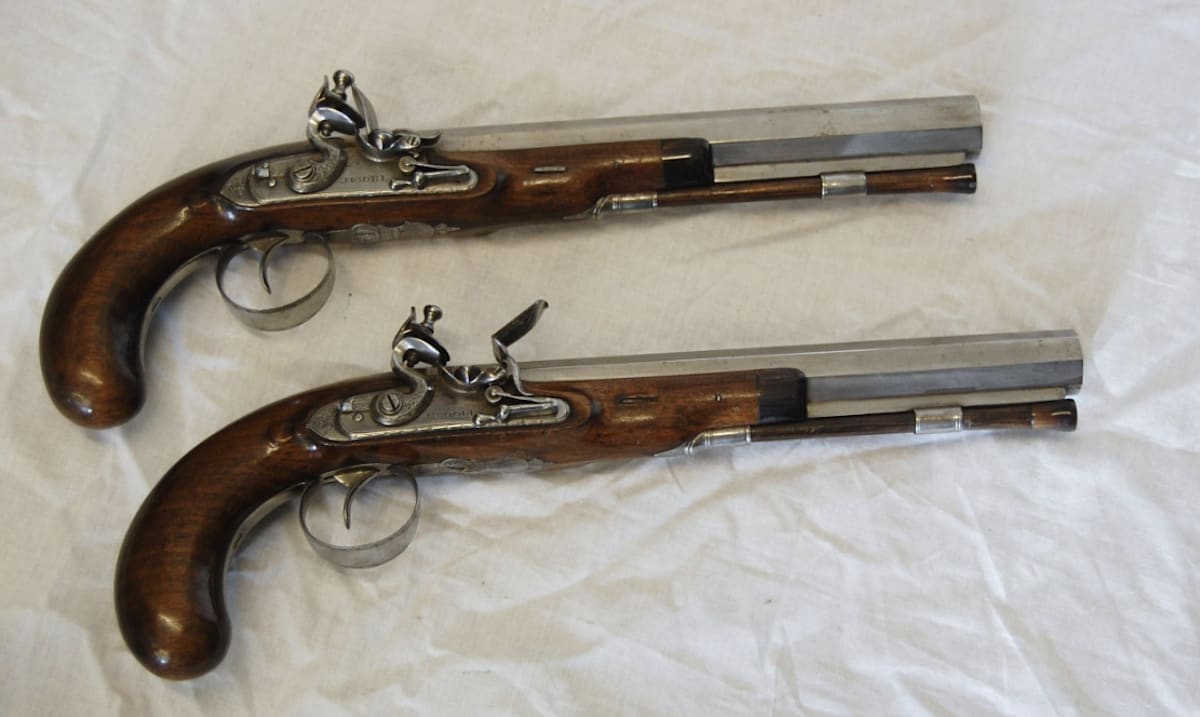
By 1811, the classic British dueling pistol was a specialized weapon.
Fine gunmakers produced matched pairs of flintlock pistols specifically intended for such encounters.
They were generally smoothbore, single-shot weapons, carefully balanced and made with considerable precision.
The pistols might be kept together in a fitted wooden case containing accessories for loading and maintaining them.
A wealthy gentleman such as Mr. Darcy could certainly own an excellent pair of pistols.
They might serve for personal protection while traveling as well as being available for the darker possibility of an affair of honor.
Jane Austen and the Duel
Jane Austen actually gives us a duel in Sense and Sensibility.
Colonel Brandon discovers that Willoughby has seduced his young ward, Eliza, abandoned her, and left her pregnant.
Brandon confronts him. The two men meet by appointment.
Austen does not give us a dramatic scene of pistols raised beneath a gray morning sky. Instead, Colonel Brandon later tells Elinor Dashwood about the encounter with remarkable brevity.
They met. They returned unwounded. That is all Austen's story requires. Her restraint is revealing.
She apparently did not need to explain to her contemporary readers what such a meeting meant. They understood the code of honor and the danger involved.
Colonel Brandon believed that Willoughby's treatment of a vulnerable young woman demanded satisfaction.
That is strikingly close to the situation Elizabeth fears in Forsaking All Others.
Darcy and the Field of Honor
This is one reason dueling works so naturally within a Pride and Prejudice variation.
Fitzwilliam Darcy is exactly the sort of gentleman for whom honor matters deeply.
He is wealthy. He is proud of his family name.
He possesses a strong sense of responsibility toward those under his protection.
And Jane Austen herself shows us how far he will go when someone he loves is endangered. When Lydia elopes with Wickham, Darcy quietly pursues the couple, pays Wickham's debts, arranges the marriage, and conceals his involvement.
Now imagine that the insult is directed not toward Lydia, but Elizabeth.
Imagine that a rake has threatened her reputation. Darcy might know perfectly well that dueling is illegal. He might understand that Elizabeth would be horrified.
He might recognize that he is risking his life, his estate, his family responsibilities, and possibly prosecution.
And still he would go. That is the terrible power of the code of honor.
The End of the Duel
Dueling did not suddenly disappear when the Regency ended.
Gentlemen continued to fight duels in Britain well into the nineteenth century.
But attitudes gradually changed.
The law had always presented a danger, but increasingly public opinion turned against the practice as well. The military also became less tolerant of officers settling disputes through private combat.
By the middle decades of the nineteenth century, the British duel was rapidly disappearing.
The code of honor had changed.
A gentleman could finally refuse a challenge without necessarily being branded a coward.
Honor at a Terrible Price
It is easy to romanticize the field of honor. Two gentlemen. Dawn. Pistols. Seconds standing nearby. A matter of honor to be settled between men.
But beneath the romance was an extraordinarily dangerous custom. A few angry words could leave one gentleman dead and another facing prosecution.
A wife could lose her husband. A child could lose his father. An estate could lose its master.
And sometimes the dispute that caused it all could have been settled with an apology.
That is why Elizabeth's fear in Forsaking All Others is very real. She knows Darcy. She knows his pride. She knows his devotion to those he loves.
And she fears that Lord Dunwich will provoke him or commit precisely the sort of offense a gentleman might believe he cannot allow to pass unanswered.
For Elizabeth, there would be nothing romantic about seeing Mr. Darcy walk onto the field of honor.
There would only be the terrifying possibility that he might not walk away.
How To Connect With Me
Thank you for taking the time to read my blog.
If you enjoy exploring the history behind Jane Austen's world as much as I do, I hope you'll follow me here on Goodreads for future blog posts and updates on my latest book releases. You can also follow me on Amazon to be notified whenever I publish a new novel.
I'd love to connect with you on social media as well! You can find me on Instagram, Facebook, and TikTok, where I share updates on my writing, historical research, and all things Pride and Prejudice.
Book Reviews and Recommendations
If you've read one of my books, I would be truly grateful if you would consider leaving an honest review on Amazon. Star Ratings and Reviews are incredibly important to independent authors. They help other readers discover our books and make a tremendous difference in helping our stories reach new audiences.
Thank you so much for your support, and happy reading!
— Lily Michaels
Goodreads Giveaway
Forsaking All Others, A Pride and Prejudice Variation
https://www.goodreads.com/giveaway/show/444599-forsaking-all-others-a-pride-and-prejudice-variation
Follow on Amazon
https://www.amazon.com/author/lilymichaels-prideandprejudice
Follow on Facebook
https://www.facebook.com/profile.php?id=61585528987332
Subscribe to my email for updates on new releases
https://lilymichaels.com/
July 26, 2026
The Field of Honor: Dueling in Regency England