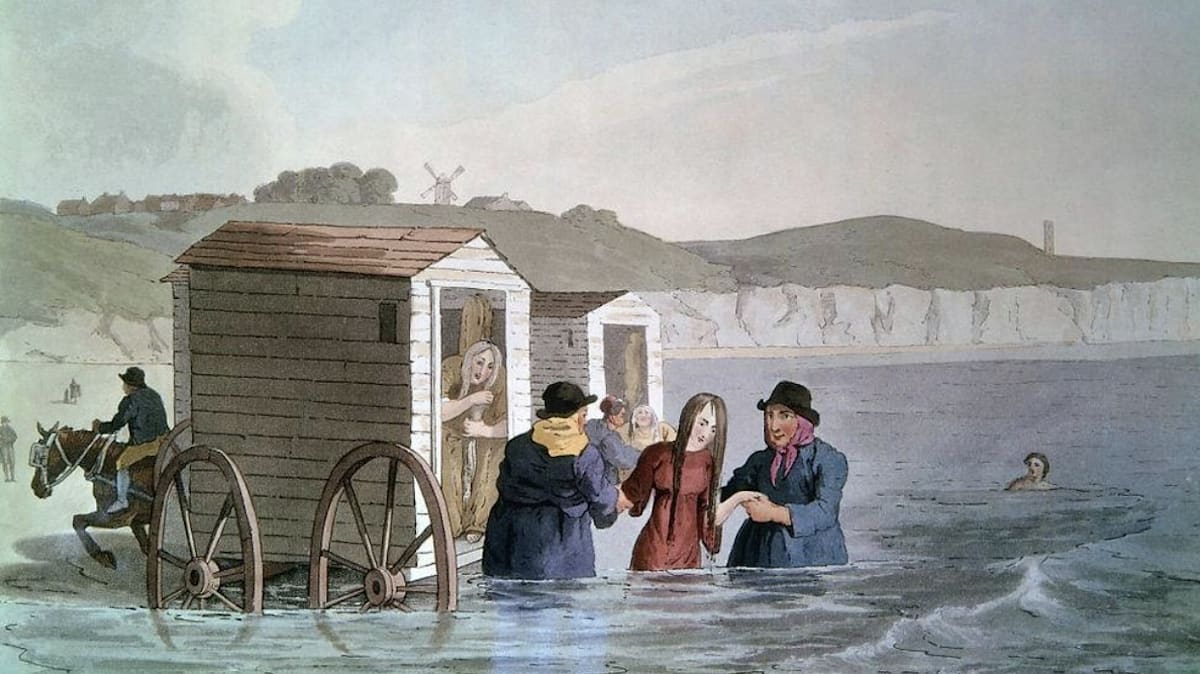
One of the pleasures of writing Pride and Prejudice variations is exploring the fascinating customs that shaped everyday life during the Regency. One such custom that appears in several of my books is sea bathing. Today we think of a trip to the seaside as a leisurely holiday filled with sunshine and relaxation, but for Jane Austen's contemporaries, sea bathing was believed to be a genuine medical treatment.
Jane Austen herself makes reference to this enthusiasm in Pride and Prejudice when Lydia and Kitty lament their inability to visit Brighton:
“If one could but go to Brighton!” observed Mrs. Bennet.
“Oh yes!—if one could but go to Brighton! But papa is so disagreeable.”
“A little sea-bathing would set me up for ever.”
“And my aunt Philips is sure it would do me a great deal of good,” added Kitty.
Such were the kind of lamentations resounding perpetually through Longbourn House.
To modern readers, their excitement may seem amusing, but it reflected a widespread belief of the time. Physicians frequently recommended sea bathing for a remarkable variety of ailments, including nervous disorders, melancholy, headaches, weakness, infertility, digestive complaints, and even poor circulation. Fresh sea air and immersion in cold salt water were thought to invigorate both body and mind.
Fashionable seaside towns flourished because of these beliefs. Brighton became perhaps the most famous resort thanks in part to the Prince Regent, who transformed it into one of England's most fashionable destinations. Ramsgate, Margate, Scarborough, Weymouth, and other coastal towns also welcomed thousands of visitors every summer seeking improved health and fashionable society.
Sea bathing itself was quite different from what we imagine today.
Ladies did not stroll onto the beach in bathing costumes. Instead, they entered a wooden bathing machine—a small hut built upon wheels. Once inside, they changed into loose woolen bathing gowns designed to preserve modesty even when wet. Horses then pulled the bathing machine into the sea until the water reached a suitable depth. From a rear door facing away from the shore, the lady stepped directly into the water, often assisted by an experienced female attendant known as a "dipper."
The experience could be quite startling. Rather than leisurely swimming, many bathers expected to be plunged briskly beneath the cold water. Some believed the sudden shock provided much of the treatment's supposed health benefits.
Gentlemen also used bathing machines, though they generally bathed separately from the ladies. Mixed bathing was considered improper in respectable society.
The seaside offered much more than bathing alone. Visitors enjoyed walks along the cliffs, carriage drives, assemblies, musicales, concerts, card parties, libraries, circulating libraries, and opportunities to meet new acquaintances. For many young ladies and gentlemen, a visit to the coast combined improved health with the excitement of fashionable society.
Jane Austen touched upon seaside life in several of her novels. In Pride and Prejudice, Brighton becomes the setting for Lydia Bennet's disastrous elopement with Wickham. The town represented excitement, military officers, and temptations beyond the quiet life of Hertfordshire. In Persuasion, the seaside resort of Lyme Regis plays a pivotal role in the story and reminds readers of both the beauty and unpredictability of the coast.
I have always found the Regency fascination with sea bathing intriguing, which is why I have incorporated it into several of my own Pride and Prejudice variations. Whether my characters are strolling the cliffs of Ramsgate, enjoying the fresh sea air, or venturing into the chilly waters, these scenes help bring Jane Austen's world vividly to life. They also remind us that what seems unusual to us today was once considered cutting-edge medical advice.
Researching customs like sea bathing deepens my appreciation for the Regency era. It was a world that combined elegant manners with medical theories that now seem rather extraordinary. Yet these historical details help us understand the hopes, fears, and daily lives of the people who inhabited Jane Austen's England, making their stories all the richer.
Thank you for taking the time to read my blog. If you enjoy exploring the history behind Jane Austen's world as much as I do, I hope you'll follow me here on Goodreads for future blog posts and updates on my latest book releases. You can also follow me on Amazon to be notified whenever I publish a new novel.
I'd love to connect with you on social media as well! You can find me on Instagram, Facebook, and TikTok, where I share updates on my writing, historical research, and all things Pride and Prejudice.
And if you've read one of my books, I would be truly grateful if you would consider leaving an honest review on Amazon. Reviews are incredibly important to independent authors. They help other readers discover our books and make a tremendous difference in helping our stories reach new audiences.
Thank you so much for your support, and happy reading!
— Lily Michaels
To Follow on Amazon: https://www.amazon.com/author/lilymichaels-prideandprejudice
https://www.amazon.com/dp/B0H6RTRFX9
#prideandprejudicevariations
#janeaustenfanfiction
#goodreadsgiveaway
#mrdarcy