There is something wonderfully romantic about a Regency letter.
A sheet of paper rests upon a writing desk. A freshly sharpened quill is dipped into an inkwell. The writer bends over the page and carefully forms each word by hand. When the letter is finished, the paper is folded, addressed, and sealed with wax before beginning its journey to someone miles away.
In Regency England, letters were far more than charming keepsakes. They were one of the principal ways people separated by distance communicated with one another.
There were no telephones, text messages, or emails. If Elizabeth Bennet wished to tell Jane something while they were apart, she wrote a letter. If Mr. Darcy needed to conduct business with his solicitor in London while he remained at Pemberley, he wrote a letter. News of births, deaths, engagements, illnesses, journeys, and family troubles often arrived in the same way.
I frequently use letters in my Pride and Prejudice variations because they were such an important part of everyday life in Jane Austen's world. And whenever one of my characters sits down to write, there is one indispensable object close at hand: the quill pen.
The Quill Pen
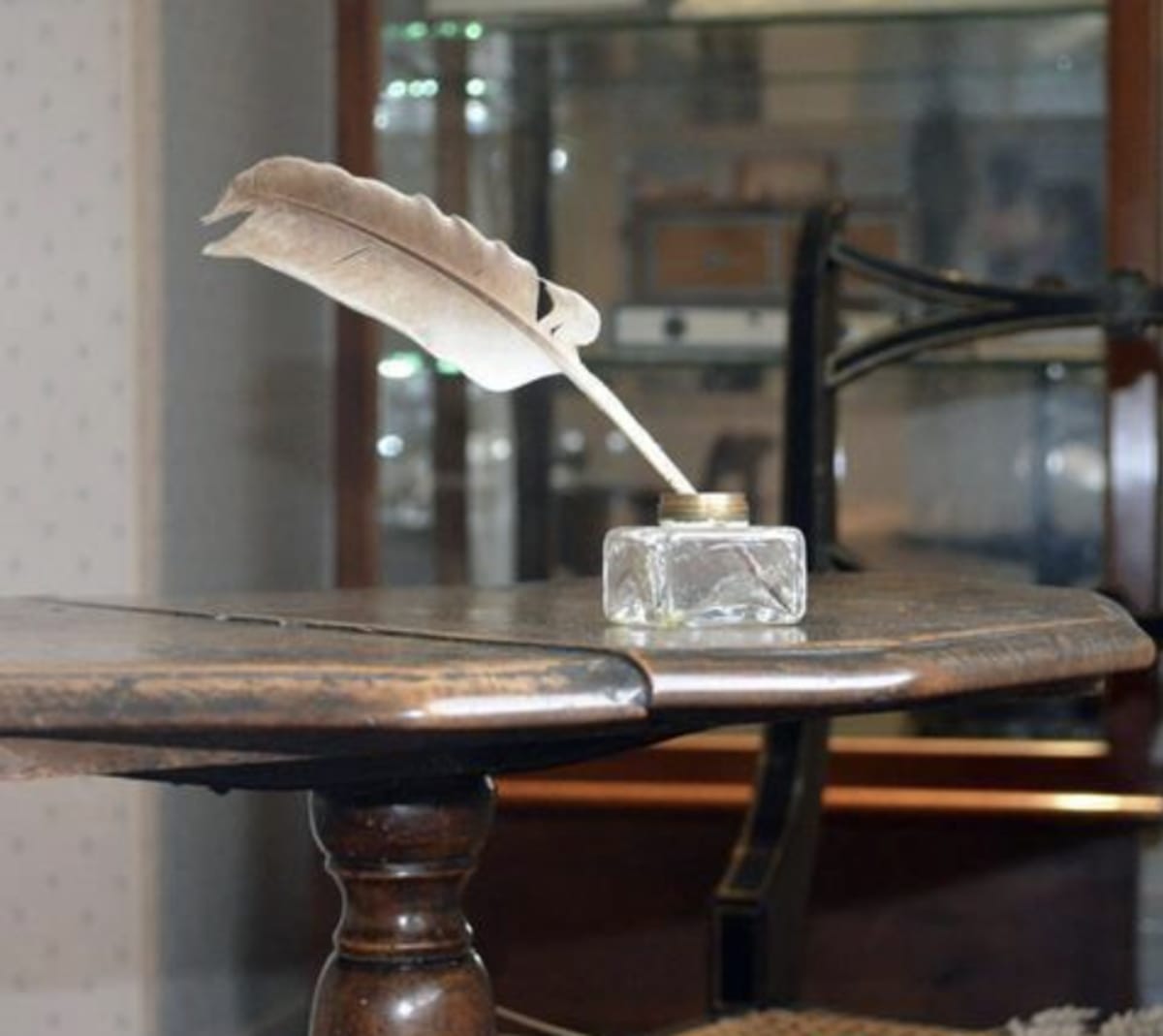
Long before the modern fountain pen or ballpoint pen, writers commonly used pens made from bird feathers.
Goose feathers were particularly suitable.
The strongest flight feathers could be hardened and carefully cut to produce a writing point. The end of the feather was shaped with a small, very sharp knife known as a penknife.
That familiar word has survived even though most of us no longer sharpen pens with one.
Preparing a quill required skill. The tip had to be cut into a nib and slit so that it could take up ink and release it as the writer formed letters upon the paper.
And unlike our modern pens, a quill did not contain its own supply of ink.
The writer repeatedly dipped the nib into an inkwell.
Too much ink could produce a blot. Too little meant another dip was necessary after only a few words.
The point also wore down with use and periodically had to be trimmed or recut.
Imagine writing a long, emotional letter while also having to maintain the instrument with which you were writing it.
That was simply part of the process.
Beautiful Handwriting Mattered
Handwriting was an important accomplishment.
Children who received a good education were taught penmanship, and copybooks provided examples of letters and writing styles for pupils to imitate.
A practiced hand could produce remarkably elegant script. Letters might slope consistently across the page, with graceful loops, flourishes, and carefully formed capitals.
But handwriting was not merely decorative.
It could reveal something about the writer.
A hurried letter might look very different from one carefully composed for a formal correspondent. An educated gentleman's business hand might differ from the graceful hand cultivated by an accomplished young lady.
For a novelist, this offers wonderful possibilities.
A character might recognize a letter before reading the signature simply because the handwriting is familiar.
A trembling hand might betray distress. Blots and crossed-out words might reveal agitation.
A beautifully controlled hand might conceal very strong emotion. The handwriting itself becomes part of the story.
Ink and the Inkwell
Jane Austen wrote using iron gall ink, one of the most common writing inks of her period.
Iron gall ink had been used in Europe for centuries. It was traditionally produced using ingredients that included oak galls and iron salts.
Fresh ink could appear lighter when first placed upon the paper and then darken as it oxidized. Many surviving historical manuscripts written with iron gall ink have remained legible for centuries, although the chemical properties of the ink can also damage paper over very long periods.
Ink could be made at home, but it could also be purchased from a stationer.
A Regency writing desk might therefore contain paper, pens, a penknife, an inkwell, sealing wax, and other small necessities.
For someone who corresponded frequently, these were ordinary household tools.
Paper Was Valuable
Paper was not something to waste. This becomes immediately apparent when looking at surviving letters from Jane Austen's lifetime. Writers frequently filled their sheets closely, making good use of the available space.
A letter commonly consisted of a sheet folded to create several writing surfaces. And there was another important difference from modern correspondence. There was usually no separate envelope. The letter itself became its own covering.
After the message had been written, the sheet was folded into a packet. Part of the outside was left available for the recipient's name and address. The folded letter could then be secured with sealing wax.
Using a separate envelope would add another sheet of paper and could increase the weight, potentially increasing the postage. Economy mattered.
Sealing the Letter
Sealing wax gave Regency correspondence one of its most recognizable features.
Wax was softened with heat and dropped onto the folded paper. A seal could then be pressed into the warm wax.
A gentleman might use a signet or seal engraved with his initials, crest, or another personal device.
The hardened wax helped keep the folded letter closed during its journey.
The seal could also provide some indication of whether the letter had been opened before reaching its intended recipient.
There is something wonderfully tangible about this form of communication. The recipient did not merely receive someone's words. He or she received a piece of paper the writer had touched, folded, and sealed.
For lovers and families separated by distance, a letter could become a treasured object.
Who Paid the Postage?
Here is a Regency custom that can surprise modern readers.
The person sending a letter did not necessarily pay the postage.
Outside London's special postal arrangements, postage was commonly paid by the recipient when the letter arrived.
The amount depended in part upon the distance traveled and the number of sheets.
That made economical writing important. Adding another sheet could make a letter more expensive to receive.
This also helps explain why surviving correspondence can appear crowded to modern eyes. Writers had good reason to make full use of their paper.
Postal reform and the adhesive postage stamp familiar to us belonged to a later generation. Britain's famous Penny Black did not appear until 1840. Jane Austen never used one.
Letters Carried the News
For families separated by distance, the arrival of the post could be one of the most important moments of the day.
A letter might bring welcome news. A marriage proposal had been accepted. A child had been born. A relative was coming to visit. But a letter might just as easily bring alarming news.
Someone was dangerously ill. A family member had died. A daughter had disappeared. A financial difficulty had arisen.
This immediacy makes letters particularly useful in historical fiction. News cannot simply appear instantaneously. Someone must write it, the letter must travel, and someone else must receive it.
Distance creates delay. And delay creates suspense.
Jane Austen Was a Letter Writer
Jane Austen understood letters intimately because she wrote so many herself.
Her surviving correspondence, particularly her letters to her beloved sister Cassandra, gives us extraordinary glimpses into her daily life.
She wrote about family, neighbors, clothing, journeys, illnesses, books, marriages, acquaintances, and countless ordinary events.
Her letters can be witty, affectionate, observant, and wonderfully sharp.
They also remind us how necessary correspondence was to maintaining relationships.
When Jane and Cassandra were apart, letters helped bridge the distance between them.
Jane Austen wrote with a goose quill and iron gall ink, often filling her paper closely before folding and sealing it for the post.
The woman who created some of the most famous letters in English fiction was herself an accomplished and prolific correspondent.
Letters in Pride and Prejudice
Few Jane Austen novels demonstrate the power of a letter better than Pride and Prejudice.
Letters are everywhere in the novel. Mr. Collins announces himself to the Bennet family by letter. Jane writes to Elizabeth. Caroline Bingley communicates by letter. Mr. Gardiner sends important news.
But no letter is more consequential than the one Mr. Darcy places in Elizabeth Bennet's hands after she refuses his first proposal.
Darcy cannot persuade Elizabeth to listen to him, so he writes.
His letter explains his involvement in separating Jane and Bingley and, more importantly, reveals the truth about George Wickham.
Elizabeth reads it. Then she reads it again.
She examines Darcy's explanations against everything she believes she knows.
The letter becomes one of the great turning points of the novel because it forces Elizabeth to reconsider both Darcy and herself.
Later, letters carry the terrible news of Lydia's elopement and eventually news of the search for Lydia and Wickham.
Austen understood something storytellers still understand today. A letter can change everything.
A Letter as a Physical Connection
Perhaps what I find most appealing about Regency correspondence is its physical nature.
A letter was not simply information. Someone selected the paper. Someone sharpened the quill. Someone dipped it into ink and formed every word by hand.
The paper might bear a blot where the writer hesitated or a word scratched out and rewritten. The handwriting might become hurried with excitement or less controlled with distress.
Then the writer folded the sheet, melted the wax, impressed the seal, and sent it away.
Days later, another person held that very same piece of paper.
In my own Pride and Prejudice variations, letters often carry news, reveal secrets, create misunderstandings, or bring characters together.
For them, a letter was often the only voice a loved one could send across the miles.
More than two hundred years later, many of those letters still survive. The ink has faded. The paper has yellowed. But the words remain.
And perhaps that is the greatest romance of the Regency letter: something written with a feather, ink, and a little piece of paper could carry a human voice across both distance and time.
How To Connect With Me
Thank you for taking the time to read my blog.
If you enjoy exploring the history behind Jane Austen's world as much as I do, I hope you'll follow me here on Goodreads for future blog posts and updates on my latest book releases. You can also follow me on Amazon to be notified whenever I publish a new novel.
I'd love to connect with you on social media as well! You can find me on Instagram, Facebook, and TikTok, where I share updates on my writing, historical research, and all things Pride and Prejudice.
Book Reviews and Recommendations
If you've read one of my books, I would be truly grateful if you would consider leaving an honest review on Amazon. Star Ratings and Reviews are incredibly important to independent authors. They help other readers discover our books and make a tremendous difference in helping our stories reach new audiences.
Thank you so much for your support, and happy reading!
— Lily Michaels
Goodreads Giveaway
Forsaking All Others, A Pride and Prejudice Variation
https://www.goodreads.com/giveaway/show/444599-forsaking-all-others-a-pride-and-prejudice-variation
Follow on Amazon
https://www.amazon.com/author/lilymichaels-prideandprejudice
Follow on Facebook
https://www.facebook.com/profile.php?id=61585528987332
Subscribe to my email for updates on new releases
https://lilymichaels.com/
July 27, 2026
Quill, Ink, and Paper: The Art of Letter Writing in Regency England