If you have read Jane Austen, you already know Derbyshire as the home of Mr. Darcy and Pemberley. But long before grand country houses appeared among its hills and valleys, people were leaving their mark on the Derbyshire landscape.
Thousands of years before Elizabeth Bennet ever set foot in Derbyshire, indeed, thousands of years before the Romans came to Britain, people were building stone circles, burial mounds, henges, and other monuments across this part of England.
There is an entire prehistoric landscape to explore here. The Peak District contains stone circles and standing stones, ancient burial mounds, and mysterious earthworks. The Nine Ladies Stone Circle on Stanton Moor is part of one such complex, while Nine Stone Close is another surviving Derbyshire stone circle.
But today I want to take you to the one that captured my imagination: Arbor Low.
The “Stonehenge of the North”
Arbor Low lies high on the limestone plateau of Derbyshire, not far from the village of Monyash. English Heritage describes it as one of the most impressive prehistoric monuments in the Peak District, and it has sometimes been called the “Stonehenge of the North.”
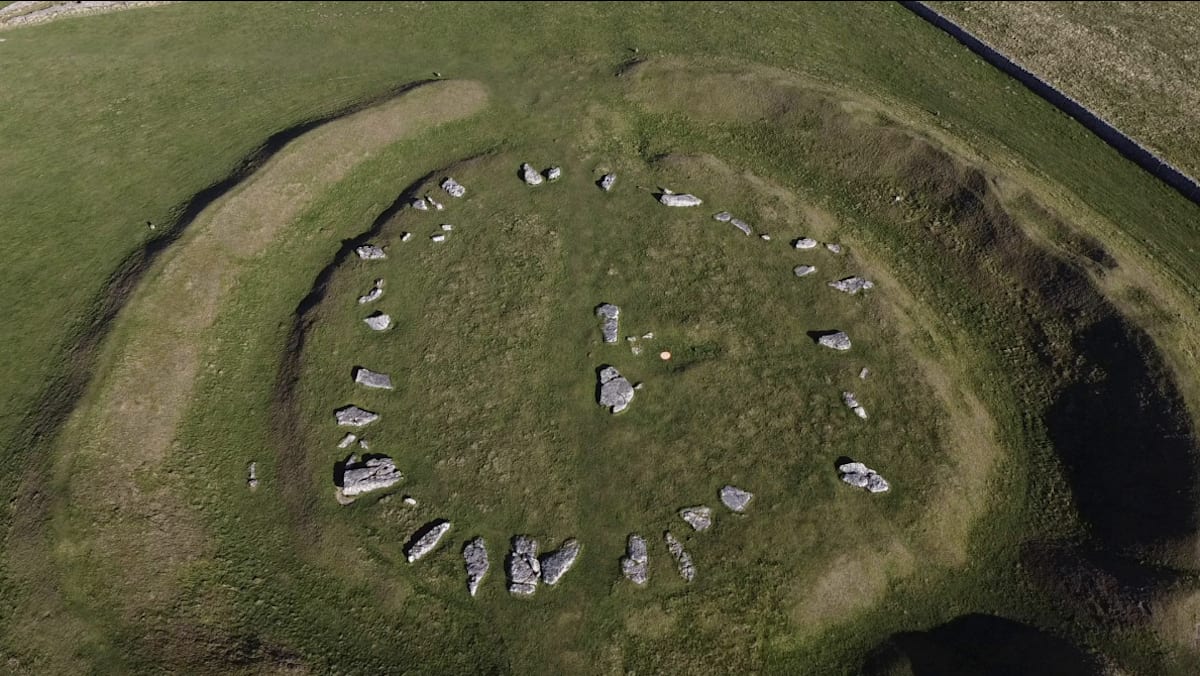
Unlike the towering stones we associate with Stonehenge, however, the stones at Arbor Low now lie flat upon the ground.
Within a great earthen bank and ditch are the remains of a large stone circle. More than fifty limestone slabs and fragments survive, and archaeologists believe the original circle may have contained approximately forty-one to forty-three stones. At its center are the remains of another stone arrangement known as the “cove.”
And Arbor Low does not stand alone.
Nearby is Gib Hill, an ancient burial mound. The two sites form part of a much larger prehistoric landscape, created and altered by generations of people over an extraordinary span of time. English Heritage suggests that the monuments at Arbor Low and Gib Hill may represent more than a thousand years of activity, perhaps from roughly 2500 to 1500 BC.
That is one of the things I find so fascinating about Arbor Low.
We can stand there today and see what remains, but we cannot know with certainty what the people who built it believed or exactly what took place inside that enormous circle. Archaeologists can study the earthworks, stones, burials, tools, and other surviving evidence, but parts of Arbor Low's story remain unknown.
And for a novelist, there is something irresistible about a place that has kept some of its secrets for more than four thousand years.
Arbor Low and The Long Road Back to Yesterday, A Pride and Prejudice Variation
Arbor Low became part of my new Pride and Prejudice variation, The Long Road Back to Yesterday.
I loved the idea of taking characters we know from the Regency world of Jane Austen and placing them against something unimaginably older—a place that was already ancient when Elizabeth Bennet and Fitzwilliam Darcy would have known Derbyshire.
In the novel, Arbor Low is more than scenery. Its age, isolation, and mystery made it exactly the sort of place I wanted for a story in which the past is not quite as safely behind us as we might suppose.
When I write a Pride and Prejudice variation, one of my favorite things is taking the familiar world of Austen and discovering what else might be hiding just beyond the edge of the page. In Derbyshire, that might be a great estate resembling the Pemberley we imagine.
Or it might be a lonely circle of stones that has been waiting on the moors for thousands of years.
Arbor Low gave me the perfect setting for The Long Road Back to Yesterday.
And once you know it is really there, I think the story becomes just a little more intriguing.
Have you ever visited Arbor Low, or any of Britain’s ancient stone circles?