How Did People Travel During the Regency? From Stagecoaches to Elegant Carriages
One of the questions I research most often while writing my Pride and Prejudice variations is surprisingly simple:
How did people travel?
Whether Elizabeth Bennet is journeying to London, Mr. Darcy is racing to Pemberley, or the Bennet sisters are visiting their aunt and uncle on Gracechurch Street, I want every mile of the journey to feel authentic.
Travel was a very different experience during the Regency. There were no railways, automobiles, or airplanes. Every journey depended upon horses, the condition of the roads, the weather, and—perhaps most importantly—the traveler's wealth.
Throughout all of my Pride and Prejudice variations, travel plays an important role. Like Jane Austen's own characters, my Bennet sisters frequently journey to London to stay with Mr. and Mrs. Gardiner on Gracechurch Street, and every trip requires careful planning. How they travel reveals much about both their circumstances and the society in which they live.
Walking: The Most Common Form of Travel
For the vast majority of people, walking remained the primary means of transportation.
Laborers, servants, apprentices, and many tradesmen walked wherever they needed to go. A journey of five or even ten miles on foot was not unusual. In towns and cities, nearly everyone walked unless they had a specific reason to hire a carriage.
Elizabeth Bennet herself demonstrates this independence when she famously walks the three miles to Netherfield through muddy fields to visit Jane.
Rather than shocking modern readers because of the distance, her walk surprised the Bingley sisters because it was considered unfashionable for a gentlewoman to arrive with muddy petticoats and flushed cheeks.
Riding on Horseback
Horseback was practical for gentlemen traveling alone.
Country clergymen, physicians, attorneys, landowners, and military officers often rode their own horses when making relatively short journeys. It was faster than walking and less expensive than maintaining a carriage.
Mr. Darcy frequently rides on horseback throughout Pride and Prejudice, particularly while at Pemberley, and gentlemen often preferred riding when speed was more important than comfort.
The Stagecoach
For commoners and the growing middle class, the stagecoach was the great public transportation system of Britain.
These coaches followed regular routes between towns and cities according to published timetables. Passengers purchased individual seats rather than hiring an entire vehicle.
Travel was not especially comfortable.
Passengers were crowded together inside narrow compartments, while hardier travelers could purchase the less expensive outside seats, exposed to wind, rain, dust, and cold.
Even so, stagecoaches connected much of England. By the early nineteenth century, improved roads allowed many routes to average seven or eight miles per hour, making travel considerably faster than it had been only a generation earlier.
The Mail Coach
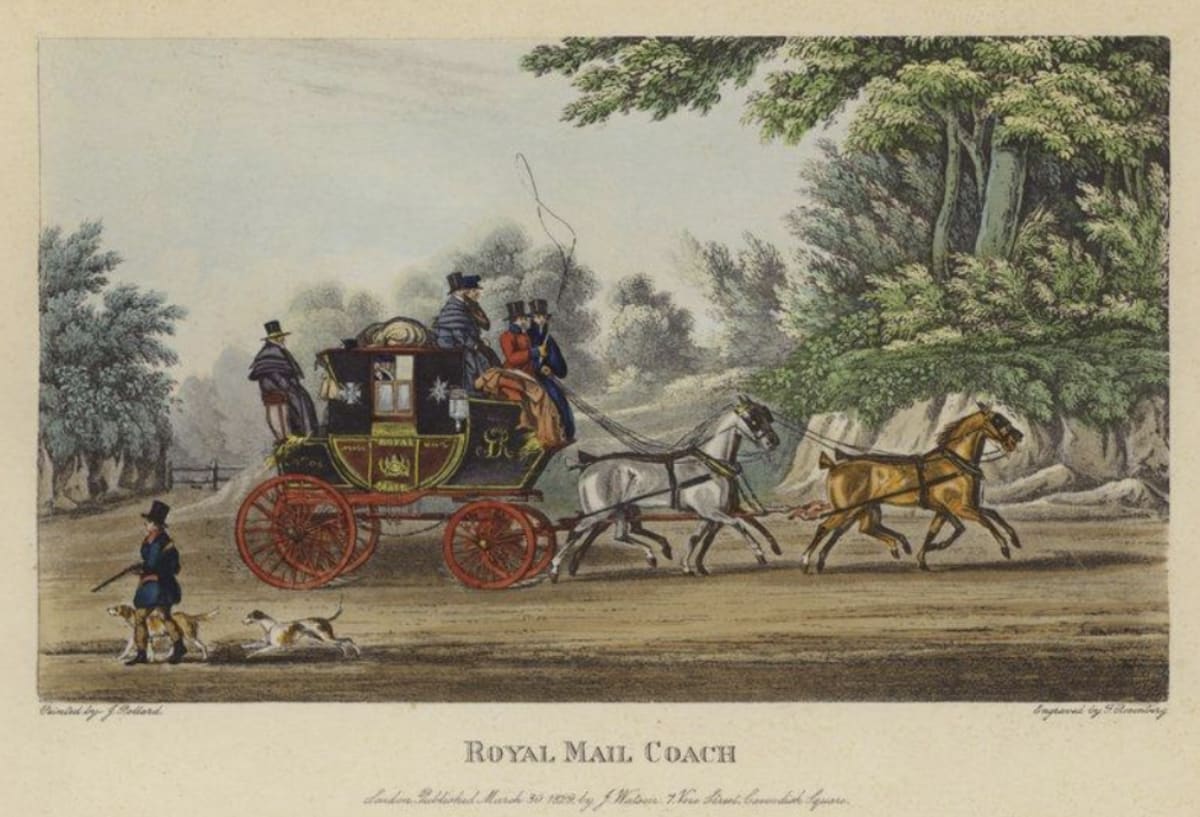
Among the fastest public vehicles was the Royal Mail coach.
Introduced in the late eighteenth century, mail coaches carried the King's mail while also accepting paying passengers. Because the mail had priority, these coaches changed horses quickly at coaching inns and maintained remarkably reliable schedules.
Traveling by mail coach cost more than an ordinary stagecoach, but it was generally faster, safer, and better managed.
Many Regency travelers considered it the best choice if they wished to reach London quickly.
Hiring a Post Chaise
Families of comfortable means often preferred to hire a post chaise.
A post chaise was a light, enclosed carriage hired together with fresh horses at successive posting inns. Unlike stagecoaches, it did not follow a fixed schedule or route. Travelers departed when they wished, stopped where they pleased, and enjoyed considerably greater privacy.
Mr. Gardiner might well hire a post chaise when taking his family on holiday, while a prosperous merchant or successful attorney could comfortably afford one for important journeys.
Families Like the Bennets
Although Mr. Bennet owned an estate, Longbourn was not among the great landed properties of England.
His income of approximately £2,000 per year made the Bennets comfortable but hardly wealthy. Maintaining an elaborate traveling carriage and a large stable of horses would have been an unnecessary expense.
When the Bennet family traveled together, they likely used their own modest family carriage for shorter distances. For longer journeys, hiring post horses or traveling by stagecoach was entirely practical.
Wealthy Families Like the Darcys
Mr. Darcy lived very differently.
With an income of £10,000 a year, he belonged to the wealthiest ranks of the landed gentry.
He maintained multiple horses, private carriages, coachmen, postilions, grooms, and servants. When he traveled between Pemberley, London, Rosings, or elsewhere, he generally did so in his own carriage, changing horses at posting inns along the route.
For urgent business, he might travel in a lighter traveling carriage capable of covering sixty to eighty miles in a day, or even farther if changing horses frequently.
His wealth purchased not only comfort but flexibility.
He traveled on his own schedule rather than anyone else's.
Coaching Inns
Every long journey depended upon the network of coaching inns scattered across Britain.
These inns supplied fresh horses, meals, overnight accommodations, stable services, and opportunities to rest before continuing onward.
Many became famous landmarks in their own right. Travelers recognized their names just as we recognize major airports today.
Without coaching inns, long-distance travel during the Regency simply would not have been possible.
Jane Austen's Travelers
Travel appears throughout Jane Austen's novels.
In Pride and Prejudice, Elizabeth journeys to Hunsford, Derbyshire, and Pemberley, while Lydia elopes to London and the militia moves from Meryton to Brighton. Every journey advances the story.
In Sense and Sensibility, the Dashwood ladies relocate from Norland Park to Barton Cottage before later traveling to London. Their movements illustrate how travel could change the course of a family's fortunes.
Austen rarely dwells on the mechanics of transportation because her contemporary readers already understood them. Today, however, these journeys offer fascinating glimpses into everyday Regency life.
Bringing Regency Travel to Life
One of my favorite aspects of writing historical fiction is recreating these journeys as accurately as possible.
Throughout all of my Pride and Prejudice variations, my characters travel the same roads Jane Austen's own characters might have followed. Whether the Bennet sisters are making their familiar journey to Gracechurch Street, Mr. Darcy is hurrying north to Pemberley, or a post chaise rattles through the countryside under a starlit sky, I enjoy weaving the realities of Regency travel into the story.
The roads were rougher, the journeys longer, and delays far more common than they are today.
But perhaps that slower pace is part of the charm.
Every journey became an adventure, every coaching inn offered new encounters, and every mile carried the promise that one's life might change before reaching the destination.
Thank you for taking the time to read my blog. If you enjoy exploring the history behind Jane Austen's world as much as I do, I hope you'll follow me here on Goodreads for future blog posts and updates on my latest book releases. You can also follow me on Amazon to be notified whenever I publish a new novel.
I'd love to connect with you on social media as well! You can find me on Instagram, Facebook, and TikTok, where I share updates on my writing, historical research, and all things Pride and Prejudice.
And if you've read one of my books, I would be truly grateful if you would consider leaving an honest review on Amazon. Reviews are incredibly important to independent authors. They help other readers discover our books and make a tremendous difference in helping our stories reach new audiences.
Thank you so much for your support, and happy reading!
— Lily Michaels
Goodreads Giveaway Link for a chance to win a free Kindle edition of Forsaking All Others, A Pride and Prejudice Variation:
https://www.goodreads.com/giveaway/show/444599-forsaking-all-others-a-pride-and-prejudice-variation
Follow on Amazon:
https://www.amazon.com/author/lilymichaels-prideandprejudice
Follow on Facebook:
https://www.facebook.com/profile.php?id=61585528987332
July 14, 2026
How Did People Travel During the Regency? From Stagecoaches to Elegant Carriages