Death was a familiar presence in Regency England.
Without antibiotics, modern surgery, vaccines for many diseases, or the medical treatments we take for granted today, families regularly lost parents, spouses, siblings, and children. Death did not merely bring private sorrow. It also brought an elaborate set of social expectations, including one that could be seen immediately by everyone a grieving person encountered.
They wore mourning.
For women, that usually meant black gowns and subdued accessories. For men, mourning might be expressed through dark clothing and especially through black hatbands or other black accessories. The depth and duration of mourning varied according to one's relationship to the deceased, social position, means, and personal circumstances.
One fabric became so closely associated with mourning that its very name can evoke the nineteenth-century widow dressed in black: bombazine.
I touch upon mourning customs in my book Dearly Beloved, A Pride and Prejudice Variation, when Mrs. Bennet passes away. Researching what her daughters and the gentlemen around them would wear led me into the surprisingly complicated world of Regency mourning.
Wearing Grief for the World to See
Today, a grieving family may wear black to a funeral and return to ordinary clothing soon afterward.
In Regency England, mourning could last considerably longer.
Mourning dress served several purposes. Most obviously, it demonstrated respect for the dead. But it also communicated something important to everyone who encountered the mourner.
A person dressed in mourning did not need to explain that there had been a death in the family.
Society could see it.
This mattered because mourning affected social behavior as well as clothing. A recently bereaved family might withdraw from balls, assemblies, dinners, theatergoing, and other entertainments. Friends and acquaintances would understand why invitations were declined and why ordinary social obligations might temporarily be suspended.
Clothing therefore became a public language of grief.
A Woman in Mourning
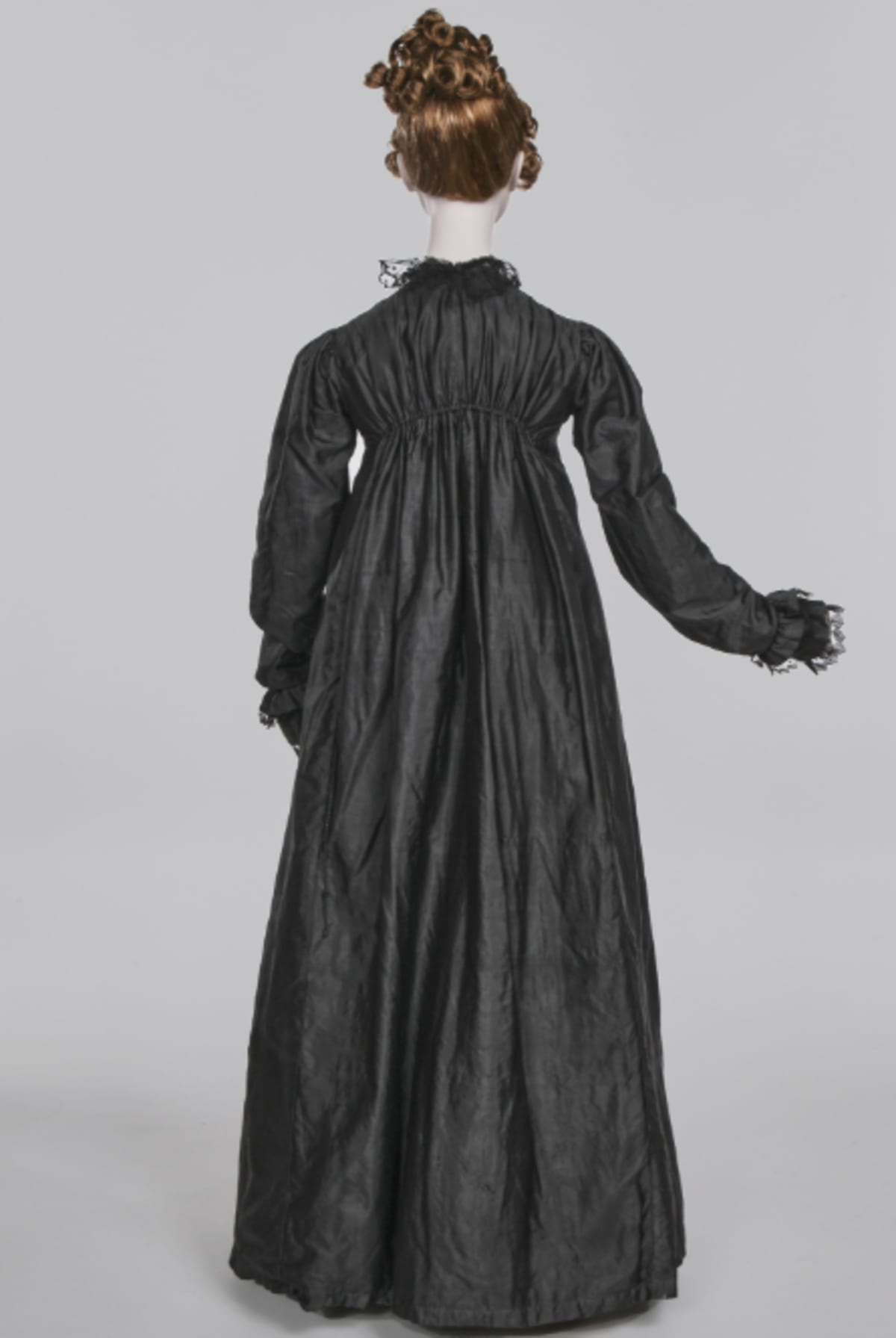
For a woman of the Bennet family's social position, mourning would require changes throughout her visible wardrobe.
Black was the dominant color.
A woman might wear a black gown with subdued trimming, avoiding the brilliant colors, decorative ribbons, flowers, and other cheerful ornaments she ordinarily enjoyed.
The fashionable silhouette did not disappear merely because a woman was grieving. A Regency mourning gown still generally followed the high-waisted, relatively narrow silhouette of the period.
That is an important distinction when we imagine mourning in Jane Austen's time.
The woman was not suddenly dressed like Queen Victoria.
She was still a Regency woman.
Her gown retained the fashionable lines of approximately 1810 or 1815, but the materials, colors, and decorations announced mourning.
Depending upon her circumstances and the degree of mourning, black gloves, ribbons, shawls, bonnets, veils, or other subdued accessories might complete her appearance.
The effect could be striking.
In an era when fashionable women's clothing embraced white muslins, delicate pastels, embroidered fabrics, colorful shawls, ribbons, and flowers, a woman dressed almost entirely in black would be immediately noticeable.
What Was Bombazine?
Bombazine, also spelled bombazeen or bombasine, is a word that frequently appears in descriptions of historical mourning clothes.
But what exactly was it?
Traditional high-quality bombazine was a mixed fabric woven with a silk warp and a worsted wool weft.
The warp consists of the threads stretched lengthwise upon the loom.
The weft consists of the threads woven back and forth across them.
In bombazine, therefore, silk provided one set of threads while worsted wool provided the other.
Worsteds were made from long wool fibers that were combed so that the fibers lay relatively parallel before spinning. The resulting yarn could produce a smoother, firmer fabric than a fuzzy woolen yarn.
The combination of silk and worsted created a durable and distinctive cloth.
The Twill Weave
Bombazine was generally woven in a twill.
If you look closely at a piece of twill fabric, you will see subtle diagonal lines running across its surface.
Those lines are created by the manner in which the weft passes over and under the warp threads. Rather than producing the simple checkerboard appearance of a plain weave, the pattern shifts with each row, creating the characteristic diagonal rib.
Twill weaving could make a fabric strong and allow it to drape well.
Bombazine was therefore practical for gowns and other garments.
When dyed black, it became particularly associated with mourning.
Why Bombazine for Mourning?
One reason bombazine suited mourning was its relatively subdued appearance.
Deep mourning generally favored fabrics that did not glitter or shine conspicuously.
A brilliant glossy silk could suggest elegance and festivity. Mourning called for something more restrained.
Bombazine could contain silk and still have a comparatively sober appearance because of its wool component and weave.
Black bombazine became so strongly connected with mourning that references to the fabric often immediately suggested bereavement.
Norwich became particularly well known for producing bombazine. By the early nineteenth century, the fabric was an important product of the city's textile industry.
For a prosperous Regency family, purchasing black bombazine after a death would therefore have been entirely plausible.
Black Was Not Always Easy
We take black fabric for granted.
A modern shopper can walk into a store and purchase dozens of garments in a consistent, deep black.
Historically, achieving and maintaining a rich black dye was much more difficult.
A good black could require complicated dyeing processes. Inferior black fabrics might fade toward brown, blue, gray, or other shades.
This meant that a fine, deep black could itself indicate quality.
For a family with money, proper mourning therefore represented another expense arriving at precisely the moment when the household was already dealing with funeral costs and perhaps the financial consequences of losing its head.
Less affluent families could not necessarily purchase an entirely new wardrobe after every death.
Existing garments might be dyed black, altered, or adapted.
Mourning customs were influenced not only by etiquette but by what a family could afford.
What Did Men Wear?
Men's mourning clothing was generally less elaborate than women's.
A gentleman could wear black or very dark clothing, particularly for the funeral and during close mourning, but one of the most visible signs of male mourning was the black hatband.
A black band, often of crape or another dark material, could be placed around the crown of a gentleman's hat.
This allowed him to announce his mourning even when the remainder of his clothing did not differ dramatically from his usual wardrobe.
Black gloves could also be associated with funerals and mourning.
Black armbands are familiar to modern readers as symbols of mourning and have a long history, although their use and form varied. For a Regency gentleman in a novel, I would be particularly comfortable using the black hatband as an unmistakable and period-appropriate sign that he was in mourning.
The contrast between men's and women's requirements is interesting.
A woman might need several black gowns and an assortment of appropriate accessories.
A gentleman could make mourning visible with comparatively modest alterations to his existing wardrobe.
Once again, women's clothing carried much of society's ceremonial burden.
Mourning Crape
Another fabric frequently associated with mourning was black crape.
Crape was deliberately given a crinkled or textured surface. Unlike smooth, gleaming silk, its uneven surface absorbed and scattered light, giving it a dull appearance well suited to mourning.
It could be used as trimming on gowns and bonnets and for veils and men's hatbands.
The absence of shine mattered.
Mourning was supposed to appear sober.
This is why understanding the fabric is useful when writing historical fiction. Simply saying that a woman wore a "black dress" misses much of what a Regency observer might have noticed.
The texture communicated meaning too.
How Long Did Mourning Last?
This is one area where writers must be cautious.
The extraordinarily detailed mourning rules many of us associate with nineteenth-century Britain reached their fullest development during the Victorian era.
Queen Victoria's prolonged mourning after Prince Albert's death in 1861 helped make mourning customs particularly elaborate and visible.
Jane Austen died more than forty years before Prince Albert.
Regency society certainly observed mourning periods and understood distinctions based upon the mourner's relationship to the deceased, but we should not automatically impose every later Victorian rule upon Austen's generation.
A widow would ordinarily mourn a husband more deeply and for longer than she would a distant cousin.
Children mourned parents.
Parents mourned children.
Brothers and sisters mourned one another.
How strictly the conventions were observed depended upon family, class, finances, circumstances, and personal feeling.
There was etiquette, but there was also life.
Mourning Was Expensive
Consider what happens when a prosperous mother dies unexpectedly.
Her daughters may need black gowns.
Perhaps they require more than one, since clothing must still be changed and cleaned.
Bonnets require suitable trimming.
Ribbons must be replaced.
Gloves may be needed.
Men require appropriate mourning accessories.
Servants might also be placed in mourning, particularly in wealthy households.
All of this costs money.
For a family such as the Bennets, respectable but not enormously wealthy, the expense would be felt.
For Mr. Darcy, the expense would hardly matter.
The same social custom therefore placed very different burdens upon different families.
Death in Sense and Sensibility
Jane Austen did not need to describe every black gown or mourning accessory for death to shape her stories.
Few of her novels demonstrate this better than Sense and Sensibility.
The novel begins with death.
Mr. Henry Dashwood dies, and his death immediately transforms the lives of his widow and daughters.
Norland passes to his son John Dashwood. Mrs. Dashwood and her daughters find themselves in reduced circumstances and ultimately leave the estate that had been their home.
The funeral has scarcely ended before the realities of inheritance intrude upon grief.
That is very characteristic of Jane Austen.
Death is emotional, but it is also practical. Someone inherits. Someone loses an income.
Someone must leave a house. Someone's prospects change.
Later in Sense and Sensibility, Marianne Dashwood becomes dangerously ill, and those who love her confront the terrifying possibility that she may die.
Austen understood that death was never merely a dramatic device. In her society, it could transform a family's financial security, residence, social position, and future overnight.
Mourning in Dearly Beloved
I explore some of these realities in Dearly Beloved, A Pride and Prejudice Variation, when Mrs. Bennet dies.
Her death means grief for her daughters, but it also means all the practical rituals that surrounded death in Regency England.
And there is the emotional adjustment to the absence of a woman who, whatever her faults, had occupied the center of her family's domestic world for many years.
These are the historical details I find particularly compelling when writing Pride and Prejudice variations.
It is easy to place Elizabeth Bennet in a beautiful gown and send her to a ball.
It is more challenging, and often more interesting, to ask what happens when the ball cannot take place.
What happens when a death occurs?
What does Elizabeth wear the next morning?
I hope you enjoyed diving into history with me and invite you to read my books if you love Jane Austen's books and have a craving for more stories that feature Mr. Darcy and Elizabeth Bennet.
How To Connect With Me
Thank you for taking the time to read my blog.
If you enjoy exploring the history behind Jane Austen's world as much as I do, I hope you'll follow me here on Goodreads for future blog posts and updates on my latest book releases. You can also follow me on Amazon to be notified whenever I publish a new novel.
I'd love to connect with you on social media as well! You can find me on Instagram, Facebook, and TikTok, where I share updates on my writing, historical research, and all things Pride and Prejudice.
Book Reviews and Recommendations
If you've read one of my books, I would be truly grateful if you would consider leaving an honest review on Amazon. Star Ratings and Reviews are incredibly important to independent authors. They help other readers discover our books and make a tremendous difference in helping our stories reach new audiences.
Thank you so much for your support, and happy reading!
— Lily Michaels
Goodreads Giveaway
Forsaking All Others, A Pride and Prejudice Variation
https://www.goodreads.com/giveaway/show/444599-forsaking-all-others-a-pride-and-prejudice-variation
Follow on Amazon
https://www.amazon.com/author/lilymichaels-prideandprejudice
Follow on Facebook
https://www.facebook.com/profile.php?id=61585528987332
Subscribe to my email for updates on new releases
https://lilymichaels.com/
July 24, 2026
Dressed in Grief: Mourning Clothes in Regency England